
Bone density drops after menopause mainly because falling estrogen lets the cells that break down old bone outpace the cells that rebuild it. For many women this shift starts a year or two before their final period, according to the National Institute of Arthritis and Musculoskeletal and Skin Diseases (NIAMS). Exercise cannot replace estrogen, but a 2023 meta-analysis in Osteoporosis International found regular weight-bearing and resistance training measurably slows the loss and can modestly raise density at some bone sites. This is information, not medical advice — talk with your own clinician about what makes sense for your bones.
Why does bone density drop after menopause?
Bone is living tissue that is constantly being broken down and rebuilt in a cycle called remodeling. Cells called osteoclasts dissolve old bone, and cells called osteoblasts lay down new bone in its place. Estrogen helps keep that cycle balanced by slowing the osteoclasts down. NIAMS explains that when estrogen declines around menopause, bone breakdown speeds up faster than bone formation can keep pace, and bone mineral density falls as a result.
NIAMS identifies low estrogen after menopause as one of the major risk factors for osteoporosis, a condition marked by reduced bone mass and weakened bone structure that raises fracture risk. The agency notes that for many women, this decline in density begins in the one to two years before their final menstrual period, not only afterward — so the process is already underway during perimenopause for some. Osteoporosis is sometimes called a "silent" disease because it produces no symptoms until a fracture happens, which is part of why screening and prevention matter before symptoms appear.
Other factors compound the estrogen effect: a smaller body frame, family history of osteoporosis, inadequate calcium or vitamin D intake, certain medications such as long-term glucocorticoids, and lifestyle factors including smoking and heavy alcohol use, per NIAMS. None of this means bone loss after menopause is inevitable to the same degree for everyone — it means the biological starting point shifts, and the factors within a person's control, including activity level, become more consequential.
How does exercise actually strengthen bone?
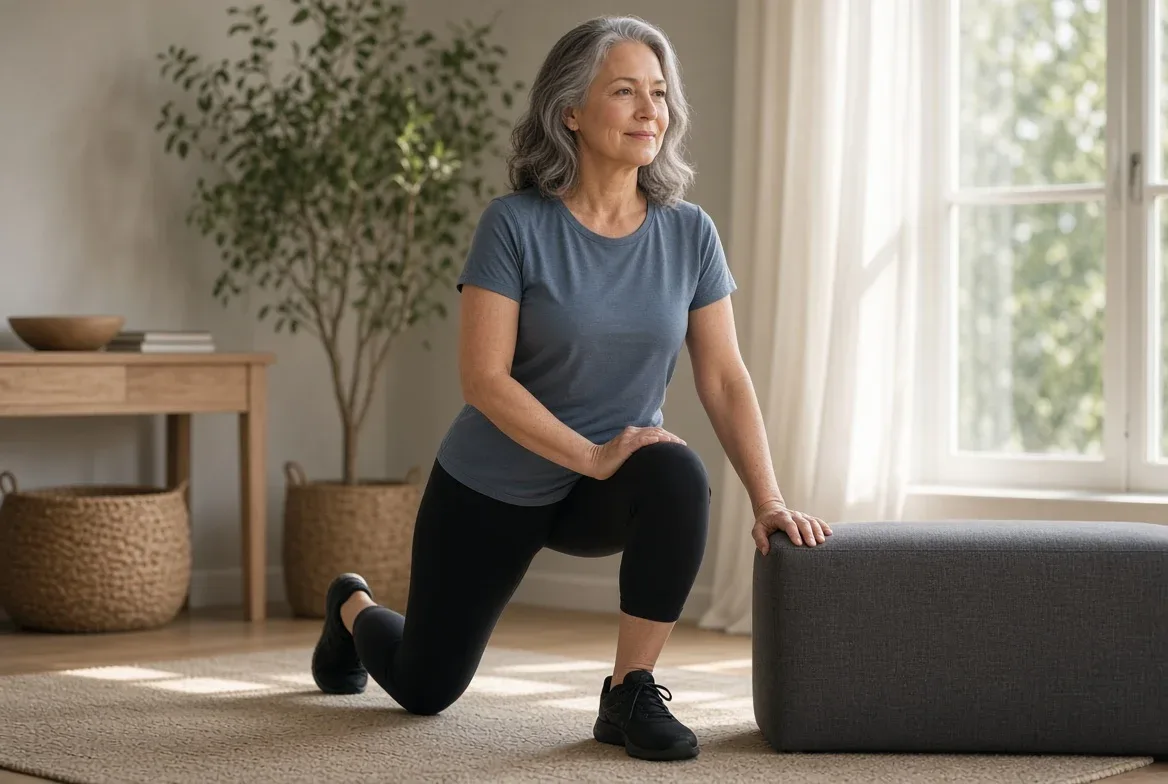
Bone responds to mechanical stress the way muscle does, though more slowly. When a bone is loaded — by the impact of a foot striking the ground, or by a muscle pulling against it during resistance training — it registers that force and responds by building new tissue at the stressed sites, becoming denser over time. NIAMS describes this directly: exercise "makes bones work harder," which stimulates them to increase in density, alongside strengthening the surrounding muscles that protect bones from falls and fractures.
This is why exercise cannot fully substitute for estrogen but can meaningfully offset its loss: the two act through different pathways. Estrogen sets the baseline rate of bone turnover; mechanical loading adds a separate, local signal that favors bone formation at the sites doing the work. That is also why NIAMS singles out weight-bearing and resistance activities specifically, rather than exercise in general — a loading stimulus needs to reach the bone for this effect to occur, which is less true of non-impact activities like swimming or stationary cycling.
Which types of exercise help the most, according to the research?
A 2023 systematic review and meta-analysis in Osteoporosis International, led by researcher R. Mohebbi and colleagues, pooled data from 80 exercise trials involving 5,581 postmenopausal women. It found small-to-moderate but consistent improvements in bone mineral density with exercise training compared with no exercise, and reported that high-impact weight-bearing exercise combined with resistance training produced the strongest results, particularly jumping-type and other impact-loading movements that generate ground reaction forces several times a person's body weight.
| Bone site | Effect of exercise vs. no exercise (standardized mean difference) |
|---|---|
| Lumbar spine | 0.29 (small-to-moderate improvement) |
| Femoral neck (hip) | 0.27 (small-to-moderate improvement) |
| Total hip | 0.41 (moderate improvement) |
The same analysis found no significant difference in benefit between supervised and unsupervised programs, or between women in early versus later menopause, or between those with normal bone density versus those with osteopenia or osteoporosis already — meaning the benefit of exercise showed up broadly across these groups rather than being limited to any one of them. The researchers did not report that any exercise type reversed osteoporosis or restored bone to premenopausal levels; the effects were described as modest reductions in loss and partial gains, not a cure.
NIAMS frames this within the same general activity target it recommends for adults overall: at least 150 minutes a week of moderate-intensity exercise, or 75 minutes of vigorous activity, combined with muscle-strengthening exercise on two or more days a week. The agency's point is not that a person needs a separate bone-specific workout on top of general fitness guidance, but that choosing weight-bearing and resistance options within that existing target — a brisk walk instead of a stationary bike, a strength session instead of a second stretching class — is what makes the routine work double duty for bone health as well as general fitness.
Who should get a bone density screening, and when?
The U.S. Preventive Services Task Force (USPSTF), in a recommendation finalized in January 2025, gives a "B" grade to bone density screening — using dual-energy X-ray absorptiometry (DXA), with or without an added fracture-risk assessment — for all women 65 and older. It gives the same "B" grade to screening postmenopausal women younger than 65 who have one or more additional risk factors for osteoporosis, such as low body weight, a parent's hip fracture, or smoking. A "B" grade means the USPSTF has found at least moderate certainty that the service provides moderate to substantial benefit. For men, the task force currently finds the evidence insufficient to recommend for or against screening.
This 2025 statement updates the task force's prior 2018 recommendation and clarifies that screening can be done with DXA alone or in combination with a fracture-risk tool. It does not change the basic threshold of age 65 for average-risk women, or the guidance to screen earlier for postmenopausal women who carry added risk factors.
A DXA scan uses x-ray beams to measure bone density at the hip and spine, typically takes 15 to 20 minutes, and involves a radiation dose the Centers for Disease Control and Prevention (CDC) describes as very low, similar to a standard x-ray. The result is reported as a T-score, comparing a person's bone density to the optimal peak density for their sex. The CDC notes that nearly 1 in 5 women over 50 have osteoporosis, which is part of why the DXA result functions as one input for a clinician assessing fracture risk, not a stand-alone diagnosis to interpret alone.
When to talk to a clinician
NIAMS' guidance points toward a conversation with a clinician, rather than self-diagnosis or self-treatment, in several situations: if you are approaching or past menopause and are unsure when you should be screened; if you have a family history of osteoporosis or a parent who fractured a hip; if you have lost noticeable height, developed a stooped posture, or experienced a fracture from a minor fall or bump, all of which can be signs of low bone density; or if a health condition or medication you take is known to affect bone, such as long-term glucocorticoid use. A clinician can also advise on exercise intensity for anyone who already has osteoporosis or a prior fracture, since NIAMS notes that people with bone health conditions should check with a provider about which exercises are appropriate for them individually.
For a related wellbeing perspective, read “Can a ketogenic diet benefit women suffering from polycystic ovary syndrome?”.