
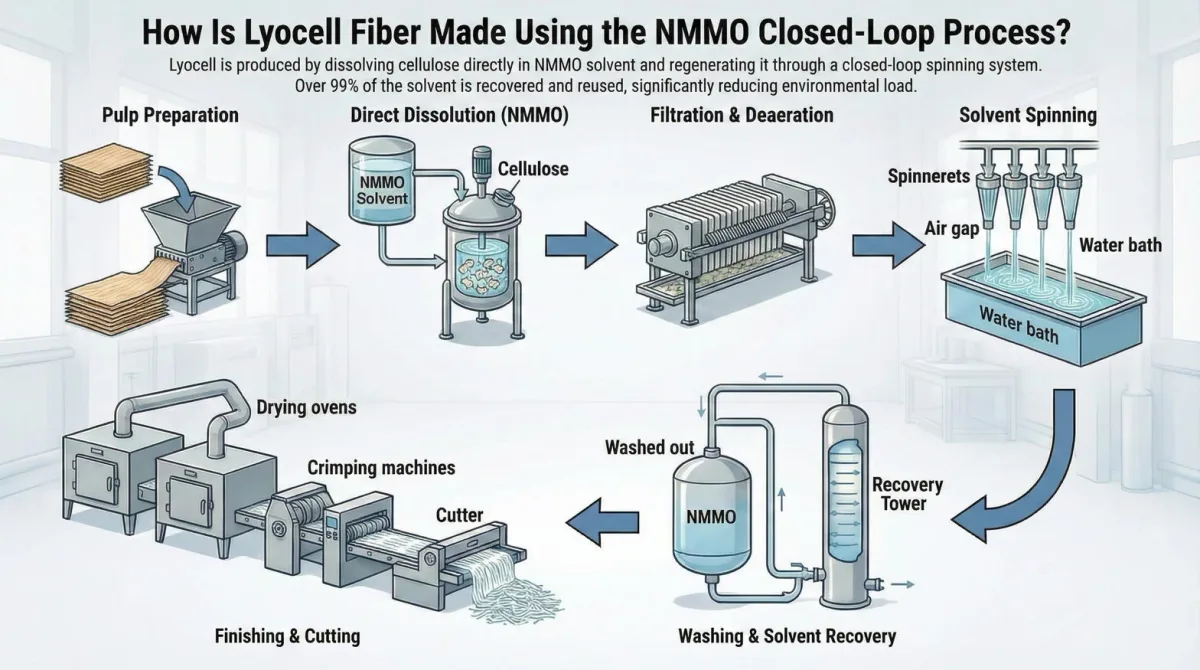
Lyocell is a cellulosic fiber spun from dissolved wood pulp using a solvent that manufacturers recover and reuse rather than discharge — at Lenzing, the Austrian producer behind the TENCEL™ brand, roughly 99.8% of that solvent is recovered and put back into the next production cycle, according to the company's own technology documentation. The figure is the reason lyocell exists as a commercial category at all.
What Actually Happens Between Wood Chip and Fiber?
Lyocell starts as dissolving wood pulp — Lenzing's process notes that "the raw material can come from wood-based cellulose or alternative cellulose sources such as cotton scraps." The pulp is suspended in a mixture of water and N-methylmorpholine N-oxide (NMMO), a tertiary amine oxide solvent that the MDPI review describes as "composed of a combination of oxidized hydrogen peroxide and the tertiary amine N-methylmorpholine," with a coordinate-covalent bond between nitrogen and oxygen that makes it effective at dissolving cellulose directly. As water is driven off under heat, the cellulose goes into solution, forming a viscous spinning dope.
That dope is filtered to remove undissolved particles, then forced through a spinneret — a metal disc pierced with hundreds of fine holes — into a dilute NMMO bath, where the filaments solidify on contact. The resulting tow is washed to strip out residual solvent, finished, dried, and cut to staple length. Lenzing describes the sequence in four stages: dissolving, filtering, spinning, and washing.
The step that separates lyocell from older regenerated-cellulose fibers is what happens to the wash water. Instead of treating the diluted NMMO as effluent, the plant routes it back through a recovery loop, concentrates it, and returns it to the front of the process. Lenzing states this closed loop recovers "approximately 99.8% of the NMMO," a figure the company presents as central to both the process's cost structure and its environmental case.
Why Does the Recovery Rate Matter This Much?
NMMO is expensive, and a 2025 peer-reviewed review of lyocell manufacturing published on MDPI's Recycling platform frames solvent recovery as a matter of plant economics as much as environmental performance, noting the solvent's "high cost" makes reuse "economically necessary" and that residual NMMO left in the finished fiber causes yellowing and strength loss if it isn't washed out and reclaimed. In other words, an incomplete recovery loop is a defect in the product, not just a compliance problem.
The same review compiles recovery performance from industrial and pilot systems, and the gap between configurations is the clearest evidence of how much engineering the loop requires:
| Recovery system | NMMO recovery rate |
|---|---|
| Six-stage industrial system | 99.5% |
| Simplified industrial system | 98.9% |
| Reported literature range | up to 99%–99.5% |
Standard recovery still relies on evaporation — rotary evaporators run under low vacuum, roughly 15 to 30 mmHg, at 80–100°C for around four hours, per the review — combined with flocculation or air flotation to strip suspended solids and ion exchange to remove dissolved contaminants before the solvent is concentrated back to usable strength. A pilot run cited in the review recovered NMMO to a 51.4% concentration by weight through rotary evaporation alone, with no measurable degradation of the reclaimed solvent.
What Does the Process Buy the Finished Fabric?
The dissolving step, not just the recovery loop, shapes what the fiber does on a mill floor. Lenzing's product documentation describes TENCEL™ lyocell as having "high moisture uptake, offering a higher perceived thermal comfort level to the wearer," moisture regulation that lets the fiber structure "absorb and release moisture," and "high tenacity" — strength the company positions as high "among cellulosic fibers" generally, a comparison against fiber type rather than against any single competing brand. The same documentation states the fiber is certified by TÜV Austria as biodegradable in soil, freshwater, and marine environments, and compostable, with third-party certification standing behind the claim rather than Lenzing's own assertion alone.
Lenzing also draws a distinction inside its own product line: it states its TENCEL™-branded lyocell delivers "at least 50 percent less carbon emissions and water consumption compared to generic lyocell," and cites Higg Materials Sustainability Index modeling putting the branded fiber up to 39% better on fossil-fuel depletion, 53% on global warming potential, 69% on water consumption, and 60% on eutrophication versus that generic baseline. Because the comparison is against unbranded lyocell rather than against cotton, polyester, or viscose, it says something about process control within the lyocell category — not about how lyocell as a fiber type ranks against other materials, a distinction the copy is careful to preserve rather than blur.
Where Does the Wood Come From, and Who Checks?
Because the fiber is wood-derived, the sourcing question sits upstream of the chemistry. Lenzing's 2021 sustainability report states that "more than 99 percent of wood and dissolving wood pulp used by the Lenzing Group is either certified by FSC® and PEFC or inspected in line with these standards," and that all Lenzing Group production sites hold FSC Chain of Custody certification, with PEFC group certification covering five sites. The company's wood and pulp policy, per the same report, restricts sourcing to semi-natural forests and plantations and excludes wood from "natural or ancient and endangered forests," including plantations created after 1994 through significant conversion of natural forest.
Canopy, the forest-conservation nonprofit that audits cellulosic fiber producers through its Hot Button ranking, scored Lenzing 34.5 out of 40 in its most recent report, placing the company in the "No Known High Risk" category for forest sourcing and giving it a full 8 out of 8 on chemical management through the ZDHC wastewater and air-emissions framework. The same report scores Lenzing 0 out of 1 on actual commercial-scale use of next-generation, non-wood cellulosic pulp — Canopy's assessment credits the company's R&D investment but notes it has not yet scaled next-gen feedstock into production volume, the metric the ranking treats as the industry's next forest-reduction lever.
Who Is Actually Buying the Fiber?
Lyocell's commercial footprint traces back to TENCEL™'s 1992 launch by Lenzing, and the brand now counts more than 300 global brand partners across denim, intimates, activewear, and footwear applications, according to trade coverage in WWD. Lenzing has also framed its climate roadmap around the fiber line, targeting net-zero emissions by 2050 and describing what it calls the industry's first carbon-zero TENCEL-branded fibers as part of that push, per the same coverage — a claim that, as with any manufacturer's own sustainability framing, is Lenzing's characterization of its roadmap rather than an independently verified emissions outcome.
For mills, the appeal is less about marketing than about processing behavior: a closed-loop fiber with a fixed, disclosed recovery rate is a more predictable input to plan chemical handling and effluent treatment around than a solvent system without published recovery data — one reason lyocell has moved from a niche substitute into a mainstream denim and wovens input rather than staying confined to premium lines.
What Limits the Process From Here
The recovery loop is close to its practical ceiling — moving from 99.5% to 99.8% is a matter of diminishing returns, not a solvable engineering gap. The constraint the sourcing data points to instead is upstream: Canopy's own scoring framework treats scaling next-generation, non-forest cellulosic feedstock as the remaining lever for reducing the category's forest footprint, a lever that, on the fiber's own producer's account, has not yet moved past the R&D stage into commercial volume.
For a related style news perspective, read 24FASHION IS A NEW GLOBAL FASHION NETWORK AND TV CHANNEL ON AMAZON FIRE TV AND ROKU TV.
For more context, read Complete Guide to Comic Book Collecting for Beginners.
For more context, read How to Run a Four-Day Week Without Losing Output.
For more context, read Skin cycling gave your skincare shelf actual rest days.