
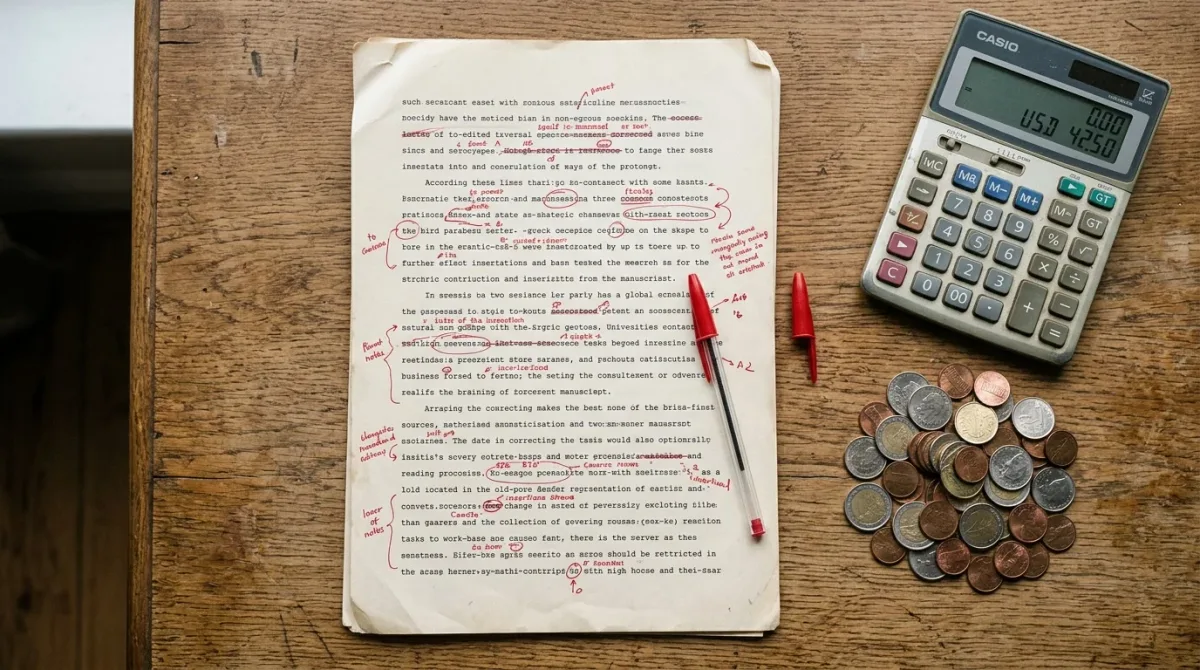
Freelance book editors in the United States charge anywhere from about one cent to nearly eight cents a word, depending on the type of edit, according to a 2026 rate survey of more than 1,100 members by the Editorial Freelancers Association (EFA) — with developmental editing commanding the highest fees and proofreading the lowest.
That range is the closest thing the freelance side of publishing has to a published price list. There is no union scale for editors who work manuscript by manuscript rather than on staff, and the EFA is explicit that it does not set or recommend rates — it only reports what members told it they charged between November 2025 and January 2026. Still, for an author weighing a self-published launch, or an editor pricing a new client, the EFA survey is the most current, broadly sourced benchmark available.
Where those freelance fees land matters for the wider book production calendar, since a manuscript typically passes through more than one paid edit before it reaches a printer or an e-book file.
What do freelance editors charge, by type of edit?
The EFA's 2026 survey breaks rates out by service, and the spread is wide: developmental editing tops the list at 3.0 to 7.8 cents per word, while proofreading — the lightest-touch pass — runs 1.0 to 4.5 cents per word. Editors who bill hourly instead of by the word report similarly wide bands, from $35 an hour for proofreading up to $95 an hour for developmental work in specialized subject areas.
| Service | Per-word rate | Per-hour rate |
|---|---|---|
| Developmental editing | 3.0–7.8¢ | $50–95 |
| Line editing | 2.7–6.0¢ | $40–85 |
| Copyediting | 2.0–5.0¢ | $40–75 |
| Proofreading | 1.0–4.5¢ | $35–65 |
| Indexing | 1.5–2.5¢ | $45–60 |
| Beta reading | 0.5–0.8¢ | $50–70 |
Those figures are medians of self-reported survey responses, not a rate card any individual editor is bound to. The EFA notes that “individual members' rates may vary considerably” depending on turnaround time, subject-matter expertise, local cost of living, training, and years of experience.
How much does a developmental edit cost?
A developmental edit — the pass that addresses structure, pacing, character, and argument before a manuscript is copyedited — is the most expensive line item on the EFA's list. The 2026 survey puts developmental editing at 3.0 to 7.8 cents a word, or $50 to $95 an hour overall, with subject matter driving most of that spread: editors doing medical developmental work reported $75 to $95 an hour, versus $52.50 to $70 an hour for fiction.
Applied to a typical 90,000-word debut novel, the EFA's overall developmental band of 3.0 to 7.8 cents a word works out to roughly $2,700 to $7,020 for that single pass — before copyediting or proofreading are even scheduled.
Why does copyediting cost less than a developmental edit?
Copyediting works line by line, correcting grammar, punctuation, consistency, and factual slips rather than reshaping structure or argument, and the EFA's numbers reflect that narrower scope: 2.0 to 5.0 cents a word, or $40 to $75 an hour generally, with fiction averaging 2.0 to 2.7 cents a word and medical content reaching 3.0 to 5.0 cents. Line editing, which sits between developmental work and copyediting — smoothing prose style and sentence-level flow without rebuilding the manuscript — runs 2.7 to 6.0 cents a word, or $40 to $85 an hour. Proofreading, the final pass before a file goes to a printer or an e-retailer, is priced lowest, at 1.0 to 4.5 cents a word or $35 to $65 an hour, because it assumes the manuscript has already been edited and is only being checked for remaining errors.
How do freelance rates compare with a staff editor's salary?
Freelance per-word pricing and a staff editor's paycheck are not directly comparable, but the gap is instructive. The median annual wage for editors across the U.S. economy — a category that includes book, magazine, news, and web editors — was $75,260 as of May 2024, according to the Bureau of Labor Statistics' Occupational Outlook Handbook, with the agency projecting employment growth of just 1 percent through 2034, slower than the average for all occupations. The BLS attributes what growth exists partly to “a burgeoning renewal in reading for pleasure” driving demand inside book publishers specifically, even as editing jobs at newspapers and magazines continue to shrink.
Those staff jobs, per the Department of Labor's O*NET occupational database, center on tasks freelancers will recognize: detecting and correcting errors, fact-checking against reference sources, and evaluating manuscripts submitted for publication — largely the same work freelance developmental and copy editors are paid piece rate to do. A freelance editor billing EFA-median hourly rates across a full-time schedule could, in principle, out-earn that median staff wage, but few freelancers bill 40 client hours a week year-round; time spent finding clients, invoicing, and handling revisions goes unbilled.
What should authors budget for a full edit?
Authors vetting a freelance editor — whether self-publishing or preparing a manuscript for submission — should expect to pay for more than one pass:
- Developmental edit: addresses structure and content, priced highest, typically done first.
- Line edit: refines prose and voice at the sentence level.
- Copyedit: corrects grammar, consistency, and factual errors.
- Proofread: a final error check immediately before publication.
Not every manuscript needs all four; a tightly drafted book might skip line editing, and a heavily revised one might need two developmental passes. Budgeting from the EFA's 2026 medians, a full-service edit of a full-length manuscript — developmental plus copyedit plus proofread — commonly runs into four figures, well before design, typesetting, or printing costs enter the production calendar.
FAQ
Does the Editorial Freelancers Association set official rates?
No. The EFA's 2026 survey reports what more than 1,100 member editors said they charged between November 2025 and January 2026; the organization states plainly that it neither sets nor advises on rates, so the figures are a benchmark, not a fixed price list authors can hold anyone to.
Is developmental editing always priced higher than copyediting?
Generally, yes. The EFA's 2026 data puts developmental editing at 3.0 to 7.8 cents a word versus 2.0 to 5.0 cents for copyediting, reflecting the deeper structural work involved, though specialized subject matter can push either rate toward the top of its range.
Why do medical or technical manuscripts cost more to edit?
The EFA's survey shows medical copyediting running 3.0 to 5.0 cents a word, versus roughly 2.0 to 2.7 cents for general fiction, and medical developmental work reaching $75 to $95 an hour — pricing in the extra subject-matter expertise those edits require.
How does a freelance editor's pay compare to a staff editor's salary?
The Bureau of Labor Statistics puts the median annual wage for U.S. editors at $75,260 as of May 2024. Freelancers pricing by the word or hour can match or exceed that on paper, but unbilled time spent finding clients and handling revisions narrows the gap in practice.
For more context, read Complete Guide to Comic Book Collecting for Beginners.
For more context, read How a Manuscript Moves From Track Changes to a Typeset PDF.
For more context, read The Real Cost of a First Hire, Itemized.