
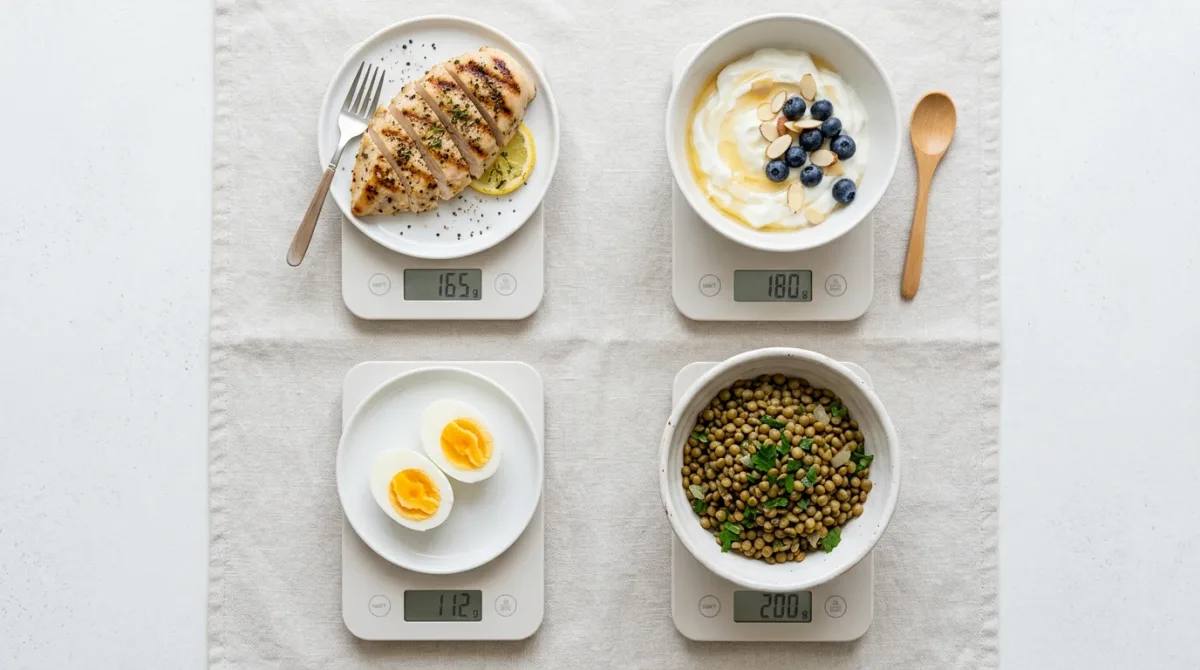
Research puts the practical ceiling for muscle-building benefit at roughly 1.6 grams of protein per kilogram of body weight daily, per a 2018 meta-analysis in the British Journal of Sports Medicine pooling 49 resistance-training trials — a narrower, evidence-based figure than the range often repeated in gyms, and well above the federal government's baseline for simply avoiding deficiency.
The gap between those two numbers — a government minimum built for the general population and a performance threshold built for people lifting weights — is where most of the confusion about protein lives. Elite Sports Mag reviewed the primary research behind each figure to sort out what is actually supported and where the evidence runs out. This is general information, not individualized nutrition advice; readers with kidney disease, other medical conditions, or specific performance goals should work with a registered dietitian or physician.
What does the research say the upper limit actually is?
The most detailed answer comes from Robert Morton and colleagues' 2018 meta-analysis and meta-regression in the British Journal of Sports Medicine, which combined 49 randomized controlled trials and 1,863 participants. Using a biphasic regression model on a subset of 42 study arms, the authors found that protein intakes above about 1.62 grams per kilogram of body weight per day produced no further measurable gains in fat-free mass from resistance training.
The confidence interval around that number was wide — 1.03 to 2.20 grams per kilogram — which the authors themselves flagged as a limitation, not a precise cutoff. In practical terms, the analysis supports roughly 1.6 grams per kilogram as a reasonable target for adults doing structured resistance training, with diminishing returns above it rather than a hard wall.
What do sports nutrition guidelines actually recommend?
The International Society of Sports Nutrition's position stand, published in the Journal of the International Society of Sports Nutrition in 2017 by Ralf Jäger and 20 co-authors, recommends a broader range: 1.4 to 2.0 grams of protein per kilogram of body weight daily for exercising individuals trying to build and maintain muscle mass.
The position stand also addresses distribution, not just total intake. It states protein should be spread evenly across the day, roughly every three to four hours, and notes the muscle-building response to a single bout of resistance exercise stays elevated for at least 24 hours — which is why the group treats total daily intake as more important than the timing of any one meal. The paper further notes that intakes above 3.0 grams per kilogram per day may have positive effects on body composition specifically in resistance-trained individuals, a narrower and less certain finding than the core recommendation.
How does that compare with the government's official protein guidance?
The federal Recommended Dietary Allowance is 0.8 grams of protein per kilogram of body weight per day, a figure documented in the Institute of Medicine's Dietary Reference Intakes report, hosted by the National Institutes of Health. That number was derived largely from nitrogen-balance studies in young adult men and extended to women after researchers found requirements did not differ substantially once adjusted for body weight.
The same report states plainly that "there is little evidence that muscular activity increases the need for protein, except for the small amount required for the development of muscles during physical conditioning," and that no increment is added to the RDA for work or training. That is a real conflict in the evidence base worth stating directly: the RDA was designed as a floor to prevent deficiency in a general, largely sedentary population, not as a target for people trying to build muscle through resistance training. Sports nutrition researchers have since built a separate, higher evidence base specific to that goal — the two numbers are answering different questions, not contradicting each other.
Is there a real downside to eating more protein than you need?
The picture on excess protein is less settled than the picture on the muscle-building floor. Healthline, reporting on the topic in an article last updated in January 2025, cited UCLA senior dietitian Dana Ellis Hunnes recommending against exceeding roughly 1.3 grams per kilogram daily — a more conservative ceiling than either the ISSN position stand or the Morton meta-analysis — while also citing a 2020 study finding that higher-protein diets did not increase measured risk to kidney or bone health in the populations studied.
That is a genuine disagreement among credentialed sources, not a settled consensus, and it is worth reading as such: some registered dietitians favor caution near the middle of the sports-nutrition range, while the resistance-training-specific research finds no measurable ceiling on muscle-building benefit until somewhere above 1.6 grams per kilogram. Readers with kidney disease or other conditions affecting protein metabolism should get individualized guidance from a physician or registered dietitian rather than applying general population research to their own case.
What does this look like at different body weights?
Translating the research ranges into daily grams makes the numbers easier to apply. The table below uses the ISSN position stand's 1.4-to-2.0-gram range and the Morton meta-analysis's roughly 1.6-gram threshold, both expressed per kilogram of body weight per day.
| Body weight | ISSN range (1.4–2.0 g/kg) | Morton meta-analysis threshold (~1.6 g/kg) |
|---|---|---|
| 60 kg (132 lb) | 84–120 g | ~97 g |
| 75 kg (165 lb) | 105–150 g | ~121 g |
| 90 kg (198 lb) | 126–180 g | ~145 g |
These figures describe averages from group-level research in healthy adults doing structured resistance training — they are not individualized prescriptions, and factors such as total calorie intake, training status, and age can shift where an individual actually benefits most.
So what is the honest bottom line?
For a healthy adult engaged in regular resistance training, the published research converges on a range of roughly 1.4 to 2.0 grams of protein per kilogram of body weight per day, with the strongest single dose-response estimate — from the Morton meta-analysis — landing near 1.6 grams per kilogram before additional protein stops producing measurable extra muscle gain. That is substantially higher than the government's 0.8-gram RDA, which was never designed to answer the muscle-building question in the first place, and it sits at or below the more conservative ceiling some registered dietitians recommend for general safety. None of this is a substitute for individualized guidance, and readers managing kidney disease, pregnancy, or other conditions that affect protein metabolism should consult a physician or registered dietitian before changing their intake.
For more context, read Complete Guide to Comic Book Collecting for Beginners.
For more context, read How Much Protein You Actually Need When You Train.
For more context, read What the Research Says About Creatine and Muscle Growth.