
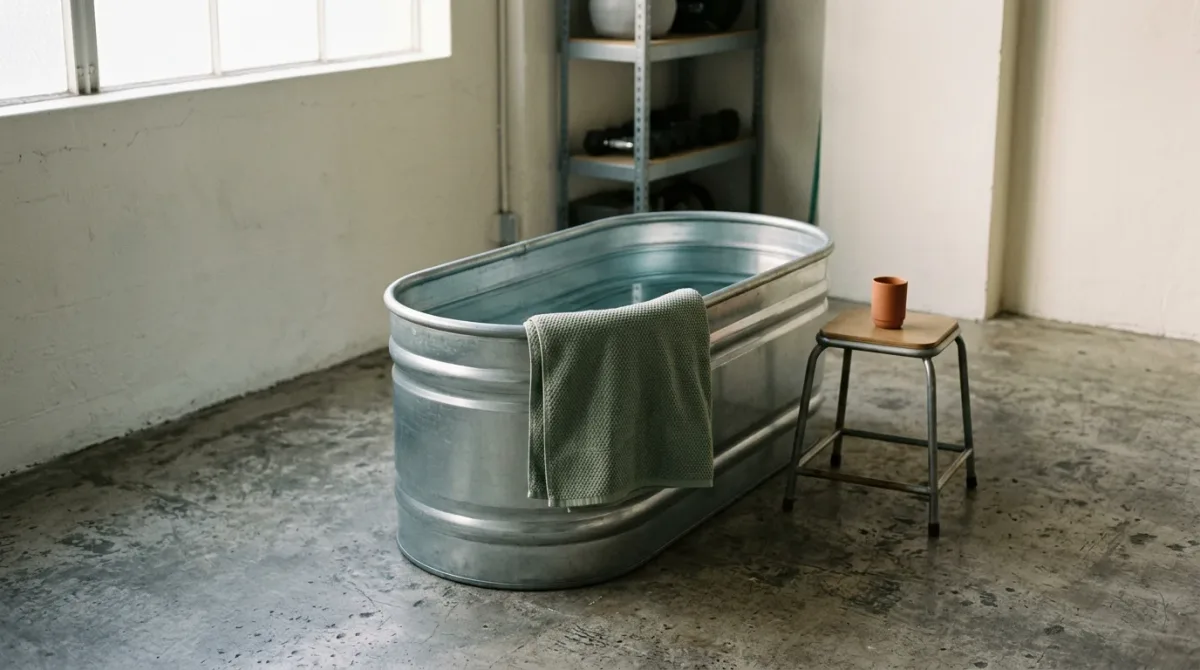
Cold-water immersion — sitting in water roughly 8 to 15°C for 10 to 15 minutes after training — has solid evidence for one thing: reducing muscle soreness in the hours after hard exercise. A 2022 review in Sports Medicine of dozens of trials confirmed the soreness effect. The complication the marketing omits: several controlled studies, including a 2015 trial from researchers at the Norwegian School of Sport Sciences, found that cold water after strength training reduced long-term muscle and strength gains compared to active recovery. Recovery and adaptation are not the same goal.
Elite Sports Mag publishes information, not medical or training advice. Cold exposure carries real risks for some people; personal decisions belong with a qualified professional.
What is cold-water immersion actually doing?
Three physiological effects, documented in exercise-science literature: blood vessels constrict (vasoconstriction), cooling tissue and slowing the inflammatory signaling that follows muscle damage; nerve conduction slows, reducing perceived soreness; and stress hormones including norepinephrine rise substantially, per the cold-exposure research of researchers like those at the Norwegian School of Sport Sciences. Feeling better after a plunge is real physiology, not placebo — the question is whether feeling better serves your goal.
When does it help?
When the next performance matters more than growing from the last one. For athletes in tournament settings, multi-stage competitions, or congested weekly schedules, blunting soreness to train or compete again tomorrow is a rational trade, and the evidence supports that use: reduced soreness and preserved performance in repeat-effort protocols, per the Sports Medicine review. Endurance athletes training twice daily are the textbook case.
When does it work against you?
When the goal is hypertrophy or strength from a training block. The inflammatory response cold water suppresses is part of the adaptation signal itself.
| Goal | Cold plunge after training | Evidence |
|---|---|---|
| Reduce soreness | Works | Consistent across trials |
| Compete again soon | Reasonable trade | Repeat-performance protocols |
| Build muscle | Counterproductive | 2015 Norwegian trial and follow-ups: reduced gains |
| Build strength | Same concern | Same research group's strength outcomes |
The table's bottom rows are the detail most plunge marketing skips: the soreness you are avoiding was partly the growth signal.
How strong is the evidence, honestly?
Solid for soreness, moderate and converging for the adaptation-blunting effect, and thin for almost everything else. The widely circulated claims about mood, immune function, and metabolism come from smaller, shorter, or non-exercise studies; researchers in the field, including authors of the Sports Medicine review, have publicly noted that popular claims outrun the data. One widely shared mood benefit — a dopamine-style alertness lift — has physiological support as a short-term arousal effect, but no quality evidence that post-exercise plunges improve training outcomes through mood.
What if you love your plunge anyway?
Timing solves most of the conflict. The adaptation-blunting studies placed cold water immediately after strength work; separating the plunge by several hours, or placing it on rest days, avoids the worst interference in principle — though direct evidence for the delayed-timing workaround is limited, as the researchers note. If training is in the evening and the plunge is next morning, the practical risk is likely small. That is a coach-level judgment, and the honest answer is that the studies have not tested every schedule.
What about whole-body cryotherapy or ice baths at other temperatures?
Whole-body cryotherapy — the cold-air chambers — has been studied for the same soreness outcomes with similar-or-weaker effects at far higher cost, per comparative reviews; its evidence base is thinner than cold water's. Water temperature in the studied range of roughly 8 to 15°C covers most of the benefit; colder is not better-studied, and comfort drops faster than results rise.
What the trials establish: cold water reliably reduces soreness and may reduce strength and muscle gains when used right after lifting. What remains unsettled is every popular claim beyond those two — the field's own reviewers say so plainly.
For more context, read Complete Guide to Comic Book Collecting for Beginners.
For more context, read Does tart cherry juice actually speed up exercise recovery?.
For more context, read What the Research Says About Creatine and Muscle Growth.