
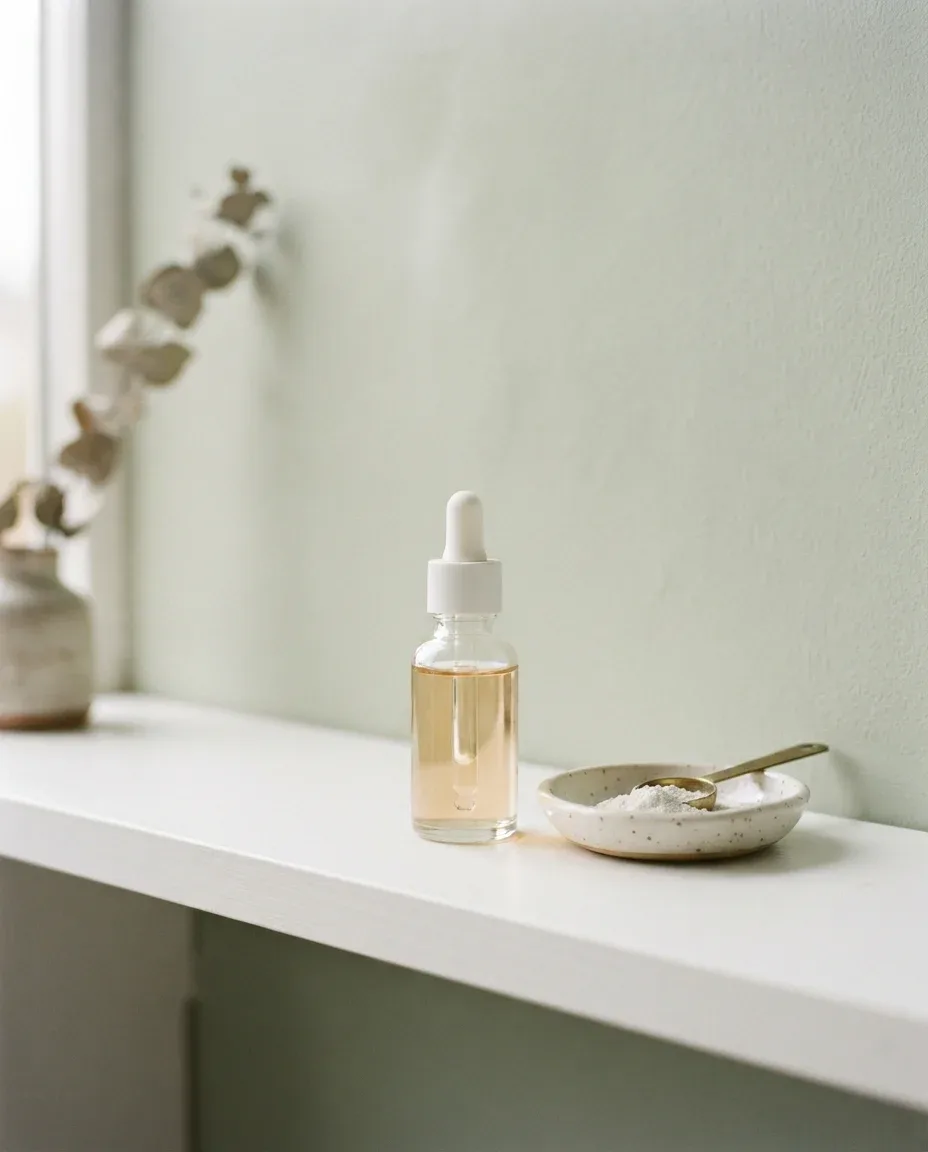
Niacinamide is a form of vitamin B3 that, at cosmetic concentrations of roughly 2–5%, has been shown in clinical studies to reduce the appearance of uneven skin tone and support the skin barrier. A frequently cited 2002 clinical study in the British Journal of Dermatology found a 5% niacinamide emulsion significantly reduced hyperpigmentation over eight weeks. The most useful fact for a routine-builder is quieter: it is one of the least reactive common actives, which is why it appears in everything from serums to cleansers.
Beautyise publishes information about ingredients from named sources, not dermatological advice; persistent skin conditions belong with a dermatologist.
Where does niacinamide come from and what is it?
Niacinamide is the amide form of niacin — vitamin B3 — and one of the two dietary forms of the vitamin the U.S. National Institutes of Health documents as essential. Applied to skin, it functions as a cell-communicating ingredient: research published in dermatology journals, including foundational work by Draelos and colleagues in 2005 and 2006, attributes to it several measurable effects. It is not an exfoliant and not an acid; it belongs to the small family of actives that work by supporting processes in the skin rather than removing or resurfacing anything.
What do the studies actually show?
Four documented effects carry reasonable evidence. Uneven tone: the 2002 Hakozaki study found 5% niacinamide reduced hyperpigmentation spots versus vehicle over eight weeks of use. Barrier support: a 2005 study in the Journal of Cosmetic Dermatology found 2% niacinamide reduced moisture loss and improved barrier function in subjects with a compromised barrier — the basis for its presence in moisturizers for dry skin. Redness and blotchiness: Draelos's 2005–2006 work documented reductions in facial blotchiness. Sebum: a 2006 study in the Journal of Cosmetic and Laser Therapy found 2% niacinamide reduced sebum production ratings in subjects with oily skin — modest, measurable, not a miracle.
What the studies do not show matters equally: no reputable trial supports niacinamide shrinking pores permanently, erasing acne, or matching pigment effects of prescription-strength hydroquinone, which is regulated as a drug in many markets.
How does it compare with other common actives?
The comparison table a routine-builder actually needs:
| Active | Documented strengths | Layering behavior |
|---|---|---|
| Niacinamide (2–5%) | Tone evening, barrier support, blotchiness, mild sebum effect | Layers with nearly everything; low irritation |
| Vitamin C (ascorbic acid) | Antioxidant protection, tone | Low pH; can be layered with niacinamide, though timing separates them for sensitive skin |
| Retinoids | Cell-turnover effects, the most studied anti-aging topical | Irritating; niacinamide pairs well and may buffer irritation |
| AHAs/BHAs | Exfoliation, texture | Alternate with retinoids; fine alongside niacinamide |
The old warning that niacinamide and vitamin C cancel each other traces to 1960s-era research on pure chemicals at high heat, and modern formulations do not recreate those conditions — a point several cosmetic chemists and dermatologists have made publicly. Pair them without ceremony; separate them by routine if your skin is reactive.
How do you use it, practically?
Concentration first: the studies behind the effects above used 2–5%, and higher percentages marketed as stronger are not better-supported by evidence and are more likely to flush reactive skin — a documented reaction at concentrations above roughly 10% that usually fades within hours. Placement follows the layering rule: a niacinamide serum goes after cleansing, before moisturizer, morning or night. It fits either routine because it does not increase photosensitivity. If your moisturizer already lists niacinamide in the top half of the ingredient list, a separate serum is optional — one well-formulated product can carry the step.
Expectations on a calendar: barrier support shows in the studies' early weeks, tone results ran six to eight weeks. Nothing topical works overnight, and this ingredient least of all — its effects are cumulative and quiet.
Who should skip it or be careful?
Genuine allergy is rare but real; flushing at high concentrations is the more common response, and sensitive-skin guidance from dermatology sources is consistent: patch-test on the inner arm for a few days, start at a lower concentration, and reduce frequency if flushing appears. During pregnancy it is considered among the safer topicals, though the honest source for any pregnancy skincare question is your own clinician, not a magazine. If a product stings beyond a brief second or two, the answer is not to push through — it is to step down the concentration or pause.
What the evidence establishes is a well-tolerated ingredient with modest, real effects on tone, barrier, and blotchiness at 2–5%. What it does not establish is everything else it is marketed for — and that gap is exactly where a reader's expectations should sit.
For more context, read Complete Guide to Comic Book Collecting for Beginners.
For more context, read Skin cycling gave your skincare shelf actual rest days.
For more context, read How to Layer Your Skincare Products in the Right Order.