
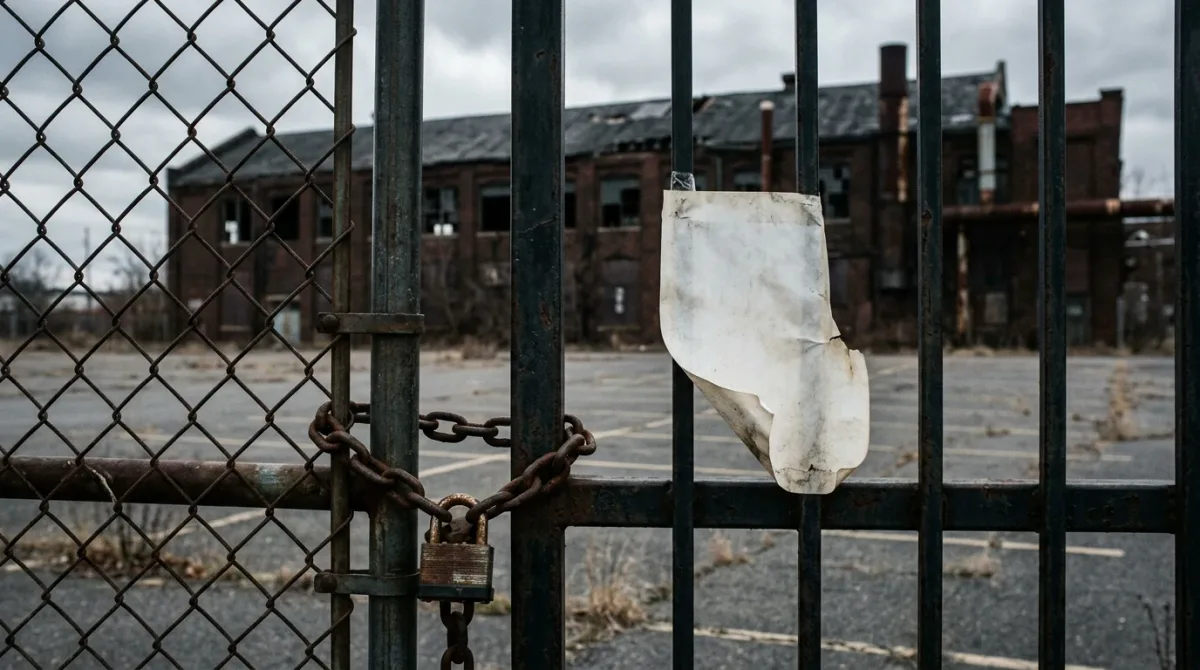
The Worker Adjustment and Retraining Notification Act buys most workers one thing: 60 calendar days of written warning, and only if their employer is large enough and the cut is deep enough to trigger it. When Grede, LLC filed to close its Meadville, Pennsylvania plant, 170 jobs entered that countdown.
The notice is not severance, not a right to the job, and not a promise that any agency will check the employer's arithmetic. It is a date, filed on a state list, that gives a workforce and a county two months to plan.
Who Is Actually Covered?
Far fewer than the statute's reputation suggests. WARN reaches employers with 100 or more employees, and only when a cut crosses one of three thresholds set out in the WARN regulations at 20 CFR Part 639: a shutdown of a single site costing 50 or more employees their jobs in any 30-day period, a layoff of 50 or more that is also at least a third of the site's workforce, or a layoff of 500 or more regardless of proportion.
That one-third test is the hinge. A 2003 Government Accountability Office review found that of the 8,350 mass layoffs and plant closures recorded in 2001, only about 24 percent appeared subject to WARN at all. Roughly 82 percent of plant closures met the criteria; only about 13 percent of mass layoffs did. Some 415,000 workers were cut in layoffs of 50 or more that fell outside the law because the employer had shed less than a third of the site.
The harder case is the employer that trims 200 people from a site of 1,000 and owes no one a letter.
What Does the Notice Have to Say, and Who Gets It?
Three parties, by regulation: the affected employees or their union representatives, the state dislocated worker unit, and the chief elected official of the local government where the cut falls. That third recipient is why these events surface publicly.
Pennsylvania publishes what it receives. The state's WARN notice list carried the Grede closure in Crawford County alongside an Essendant Management Services closure in Phoenixville affecting 150 workers and a Technica layoff of 100 in New Cumberland, all effective in the autumn of 2026. The list is an administrative record, not an enforcement one: appearing on it says nothing about whether the notice was timely, complete, or accurate.
What Are the Exceptions?
Three, and each shortens the 60 days rather than eliminating notice entirely. The faltering-company exception applies to plant closings only: the employer must show it was actively seeking capital or business, had a realistic prospect of getting it, and reasonably feared that announcing the closure would kill the deal.
The unforeseeable-business-circumstances exception covers events not reasonably foreseeable when notice would have been due — the regulations name a sudden contract cancellation or a major supplier's strike. The natural-disaster exception covers floods, earthquakes, and storms that directly cause the closure. Each is an affirmative defense the employer must prove after the fact, in court — where the statute ultimately lives.
Who Enforces It?
No one, in the sense workers usually mean. Congress assigned no agency the job. The GAO review put it plainly: the Labor Department writes the regulations and the educational materials, and "employees seeking redress under WARN must pursue their cases through the federal courts." The Labor Department says the same thing about itself, stating it has no enforcement role in seeking damages for workers who received short notice or none.
Enforcement is therefore a private lawsuit brought by employees, their representatives, or a unit of local government. The GAO counted 68 reported court decisions interpreting WARN between 1998 and 2002, and durable disagreement persists over basics — including whether the 60 days are calendar days or workdays, a dispute the GAO estimated could swing an employer's liability by about 30 percent.
What Is a Violation Worth?
Less than the phrase "60 days' notice" implies. The statute's remedies section caps back pay at the period of the violation, up to a maximum of 60 days, plus benefits under an employee benefit plan and the cost of medical expenses incurred during the employment loss. A separate civil penalty of not more than $500 for each day of violation runs to the local government that was not notified — not to the workers.
Two provisions cut exposure further. The civil penalty does not apply if the employer pays each aggrieved employee what it owes within three weeks of ordering the shutdown. And a court may reduce the liability or penalty at its discretion where the employer shows it acted in good faith, with reasonable grounds to believe it was not violating the act. Attorney's fees are likewise discretionary.
| What the statute sets out | What the record shows |
|---|---|
| 60 days' written notice before a covered closing or mass layoff | Of notices given, an estimated 68 percent met 60 days; the average was 49 days (GAO, 2001 data) |
| Notice owed at covered events | Notice was given at an estimated 36 percent of events that appeared subject to WARN — 46 percent of closures, 26 percent of mass layoffs |
| Coverage of mass layoffs of 50 or more | About 13 percent of 2001 mass layoffs appeared covered; some 415,000 workers fell outside on the one-third rule |
| Back pay up to 60 days plus benefits | Reducible at the court's discretion on a good-faith showing; the $500-a-day penalty is payable to local government, not workers |
Did the Law Change Employer Behavior at All?
Measurably, yes, even with the compliance gaps. Federal Reserve Bank of Cleveland researchers Bruce Fallick, Dylan C. Jacobs, and Pawel M. Krolikowski reported in 2024 that the incidence of advance layoff notice more than doubled after WARN took effect in February 1989, rising from roughly 9 percent of displaced workers in 1990 and 1991 to about 20 percent in 1992 and 1993.
State law moves the number too. The same work found that after New York's mini-WARN statute raised the required notice from 60 days to 90 in February 2009, the median notice there rose from close to 60 days to close to 90. Employers, in other words, generally give the minimum the law names, which makes the number a legislature picks the operative decision rather than a floor.
The same authors are candid that the harder question is unsettled: only a few recent studies, they note, have examined whether advance-notice laws actually improved labor-market outcomes for displaced workers. The evidence establishes that WARN produced notice. What two months of warning is worth in a county like Crawford, the federal record does not yet answer.
Where the Record Runs Out
The most complete federal accounting of WARN compliance remains the GAO's, and it rests on 2001 data. No comparably scoped federal audit has replaced it. Those rates describe an economy before the 2008 financial crisis and before remote work made "a single site of employment" a contested phrase — as in the SMBC MANUBANK filing on Pennsylvania's own list, which reported seven affected remote employees across various locations.
For the 170 people at Meadville, the law's practical content is narrow and knowable: a date, a filing, and a claim they would have to bring themselves if the date proves wrong.
For a related society perspective, read How the WARN Act's 60-Day Clock Actually Works.
For more context, read Complete Guide to Comic Book Collecting for Beginners.
For more context, read The Real Cost of a First Hire, Itemized.
For more context, read How to Run a Four-Day Week Without Losing Output.