
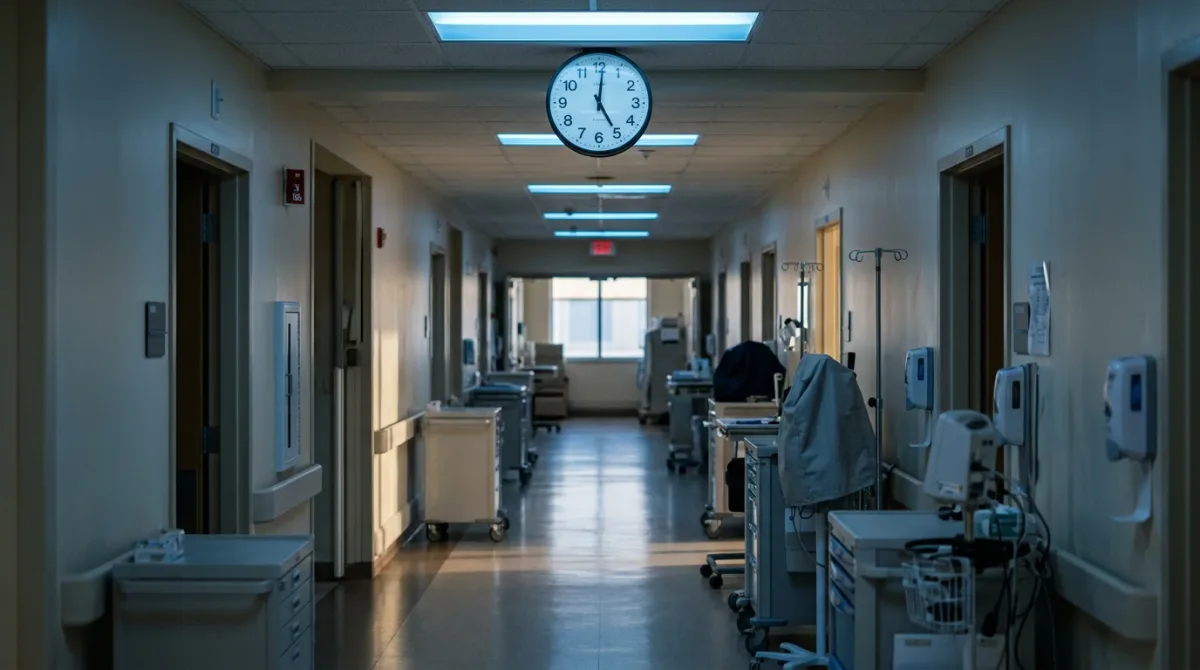
Work-related fatigue costs U.S. employers an estimated $218 billion a year in lost productivity and absences, according to an April 2023 NIOSH Science Bulletin drawing on research published in a special issue of the American Journal of Industrial Medicine. Health care is one of the sectors NIOSH flags for elevated risk, tied to extended shifts, night rotations, and chronic understaffing.
The figure is not a health-and-safety footnote for hospital finance teams. It sits alongside a separate accounting from the Occupational Safety and Health Administration, which estimates fatigue-related lost productive time costs employers $136.4 billion annually once injury claims, absenteeism, and workers' compensation are added in. Both estimates come from federal agencies that track workplace hazards, not from hospital operators or staffing vendors with a stake in scheduling practices.
How much does an extended shift actually raise injury risk?
OSHA's worker-fatigue guidance puts numbers on the pattern: evening shifts carry an 18% greater rate of accidents and injuries than day shifts, night shifts carry a 30% greater rate, and 12-hour workdays are linked to a 37% increase in injury risk compared with standard eight-hour shifts. Medical residents working extended shifts see a 16.2% increase in monthly motor-vehicle crash risk during the commute home, OSHA's summary states, citing the same body of occupational-safety research.
Those categories overlap heavily with hospital scheduling. Twelve-hour shifts are the dominant pattern for hospital nursing in the United States, and irregular and extended shifts are, in OSHA's words, "common among healthcare providers" alongside transportation workers, first responders, and other around-the-clock occupations.
What actually happens to a fatigued worker's body?
NIOSH's training curriculum for nurses on shift work and long hours traces the mechanism to sleep and circadian disruption. Extended and irregular schedules "disturb sleep and circadian rhythms and reduce time for family and non-work responsibilities," the agency's module explains, and that disruption cascades into "stress, fatigue, negative mood, discomfort, physiologic dysfunction, and poor health behaviors" such as overeating, smoking, and reduced exercise. NIOSH links the same cascade to nursing care errors that affect patients and to fatigue-related crashes during the commute home.
The 2023 NIOSH bulletin adds a healthcare-specific data point: emergency room doctors working while fatigued show elevated rates of medical error, one of six industry sectors — alongside transportation, public safety, oil and gas, mining, and agriculture — that the bulletin's authors singled out for targeted fatigue research and intervention.
Why do 12-hour shifts remain standard despite the risk data?
NIOSH's nurse-training material does not attribute the persistence of 12-hour shifts to a single cause, but it treats the schedule as one that requires deliberate safeguards rather than elimination. Citing researchers Knauth and Hornberger, the agency's module for nurses lays out six conditions under which extended shifts can be run more safely: work should avoid heavy physical demands or high stress, schedule design should prioritize fatigue reduction, staffing coverage should prevent gaps, extended shifts should not be layered with additional overtime, exposure to workplace hazards such as disinfectants and hazardous drugs should be controlled, and workers should be fully rested before returning.
NIOSH also identifies a specific failure point inside the extended-shift model: shift overruns. "Shift overruns on extended-hour shifts are common for nurses, but severely reduce the opportunity for sleep, and could lead to drowsy driving," the agency's module states — a risk compounded when nurses become accustomed to demanding conditions and stop recognizing their own fatigue buildup.
Where does the $218 billion figure come from, and who is counting?
The 2023 NIOSH bulletin's cost estimate is built from a special issue of the American Journal of Industrial Medicine, a peer-reviewed occupational-health journal, rather than from a hospital association or staffing-industry trade group. That distinction matters for how the number should be read: it is a research estimate of fatigue's drag on the broader U.S. economy, not a hospital system's internal accounting of what short staffing costs it, and not a union's estimate of what overtime scheduling costs its members. NIOSH's bulletin treats health care as one of six priority sectors for further study, alongside transportation and utilities, public safety, and extraction industries such as oil, gas, mining, and agriculture — flagged because current fatigue interventions in those fields, in the bulletin's assessment, do not adequately address the demands of the work.
OSHA's separate $136.4 billion estimate is drawn from the agency's own occupational-safety analysis and folds in a wider set of costs: workers' compensation claims, injury-related absences, and reduced output tied to fatigue rather than fatigue's productivity drag alone. Neither agency ties its national total to a single industry's share, and neither publishes a New York-specific breakdown, so the figures describe the U.S. workforce broadly rather than isolating what fatigue costs New York's hospitals, nursing homes, or staffing agencies specifically.
What this means for New York's health-care employers
The underlying scheduling pattern — heavy reliance on 12-hour shifts, chronic short staffing that pushes shift overruns, and overnight rotations — is the same one New York hospitals and staffing agencies use to fill round-the-clock coverage. NIOSH's recommendation is not to abandon 12-hour shifts but to build the six safeguards into scheduling: adequate coverage so shifts don't run over, no stacking of overtime onto an already extended shift, and unit cultures where, in the agency's language, nurses can "take reasonable breaks, leave work on time, and come to work rested."
This article describes federal occupational-safety findings; it is not medical or workplace-safety advice for any individual worker or employer.
For a related prevention perspective, read A bad night's sleep can cut immune cell activity by nearly a third, federal fatigue research shows.
For more context, read Complete Guide to Comic Book Collecting for Beginners.
For more context, read sleep quality and women's health.
For more context, read The Real Cost of a First Hire, Itemized.