
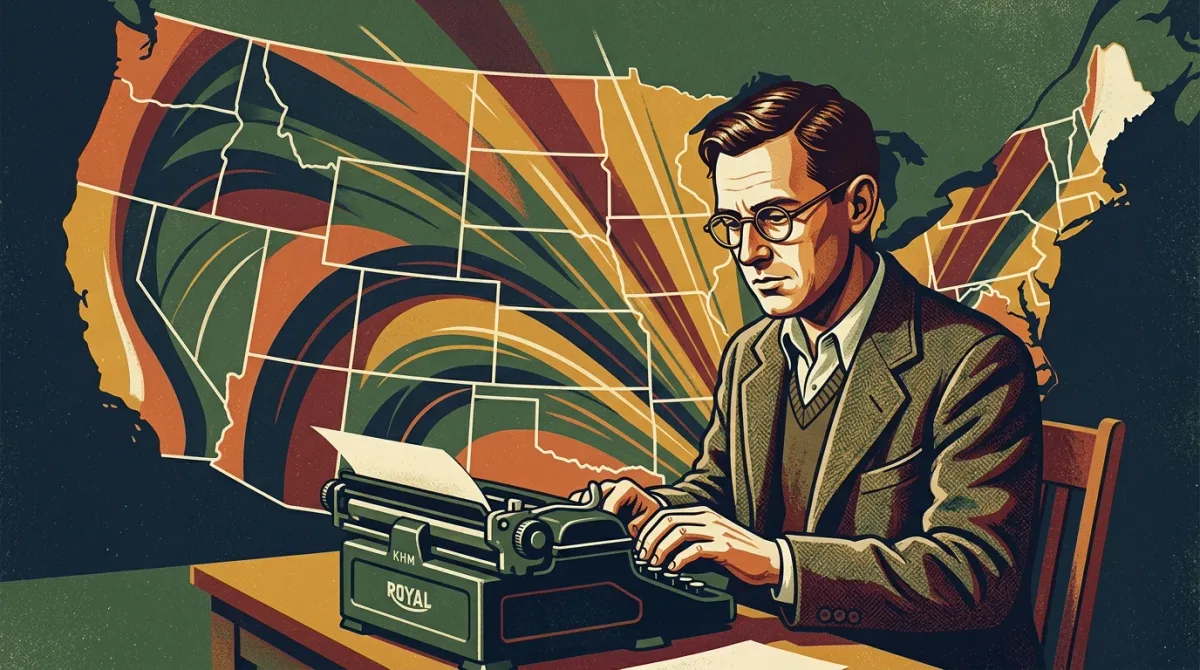
The Federal Writers' Project put thousands of unemployed writers on the federal payroll between 1935 and 1943, tasking them with cataloging American life state by state. Established July 27, 1935, under the Works Progress Administration's Federal Project Number One, it produced roughly 300,000 documents, including state guidebooks and firsthand slave narratives, before Congress cut it off.
Why Did The Government Start Paying Writers?
The Federal Writers' Project existed to give unemployed writers, journalists, teachers, lawyers, and librarians paid work in their own field instead of manual relief labor. It was one of four sister divisions under the WPA's Federal Project Number One, alongside programs for visual artists, theater workers, and musicians.
Federal One received funding approval in June 1935, and the Federal Writers' Project itself was formally established on July 27, 1935, according to the Library of Congress. Its structure was conceived by WPA administrator Jacob Baker, and Henry Alsberg — a journalist and former director of New York's Provincetown Playhouse — was named director, a post he held for the project's first four years. Federal One extended the same logic used for WPA construction crews — that skilled workers deserved paid work in their own trade rather than manual relief labor — to writers, painters, actors, and musicians, all organized under sister divisions of the same umbrella program, according to the National Archives. Because the Federal Writers' Project needed to put people on payroll quickly in every state, its early work was often mundane: building reference libraries, setting up fact-checking desks, and establishing a nationwide correspondence network between state offices and the Washington headquarters.
What Did The Federal Writers' Project Actually Produce?
The project's signature output was the American Guide Series — book-length guides to all 48 states plus assorted territories and cities, mostly published between 1937 and 1941. Field workers also gathered roughly 2,900 life histories and more than 2,300 narratives from formerly enslaved people, part of about 300,000 documents overall.
Each guide followed the same three-part formula: a long historical and cultural essay, alphabetical entries on individual cities and towns, and a series of numbered driving tours. The tours became the series' most distinctive feature under Katharine Kellock, the national editor who oversaw them, favoring what the National Endowment for the Humanities has described as "Dada-esque literary collages" that mixed the historic with the mundane. One Oklahoma tour, for instance, strung together mines, trading posts, dams, rodeo grounds, a psychiatric hospital, an airplane factory, and a petrified tree stump into a single itinerary. The slave narrative collection, gathered mostly between 1936 and 1938 and now held by the Library of Congress, remains one of the largest surviving firsthand records of American slavery told by people who lived through it.
Who Actually Wrote For The Project?
Federal Writers' Project rolls included several writers who became major American authors only after leaving it: Zora Neale Hurston, Ralph Ellison, Richard Wright, Saul Bellow, Studs Terkel, Nelson Algren, Conrad Aiken, John Cheever, and May Swenson all drew a project paycheck at some point between 1935 and 1943.
Most staff were not famous at all — the roughly 300 writers who contributed to the life-history collection alone came from 24 states, mainly journalists, schoolteachers, and out-of-work novelists rather than literary names. Fieldwork was deliberately unglamorous: writers interviewed local residents, combed courthouse and newspaper archives, and walked cemeteries and back roads looking for material, then filed drafts to a state office for a first edit before national reviewers in Washington rewrote or rejected them — a process the National Archives notes could turn contentious when local editors and Washington staff disagreed about tone or accuracy.
Why Did Congress Shut It Down?
Federal funding for the Federal Writers' Project ended in October 1939, after the House Un-American Activities Committee accused the project of harboring communist sympathizers and Congress prioritized a growing defense budget instead. Director Henry Alsberg was forced out that year, and the program survived only where individual states chose to keep funding it as the renamed Writers' Program.
The accusations came from the House Un-American Activities Committee, which by 1939 had accused the Federal Writers' Project of harboring communist sympathizers, according to the National Archives and the Library of Congress. Once direct federal appropriations stopped, states that wanted to finish or expand their guides had to sponsor the work themselves at reduced scale under the renamed Writers' Program. That state-funded remnant wound down for good within about a year of the United States entering World War II, closing completely by 1943 as the WPA itself was dissolved.
The Federal Writers' Project was not the hardest hit of the Federal One divisions. Its sister program, the Federal Theatre Project, was defunded outright by Congress in 1939 and shut down entirely that year, according to the National Archives, while the Federal Writers' Project at least survived — in reduced, state-sponsored form — for several more years. Writers kept a foothold by falling back on individual state budgets; theater did not get the same option.
What Is The Federal Writers' Project's Legacy Today?
The roughly 300,000 pages the project produced survive mainly at the Library of Congress and the National Archives, where the life histories and slave narratives are still used as primary sources unavailable anywhere else. Historians also credit the project's first-person, testimonial style with shaping the introspective turn in postwar American fiction.
The scholar Sara Rutkowski has argued that the project's emphasis on first-person testimony left a mark on the psychological, interior style of postwar American fiction, according to the National Endowment for the Humanities. The guides themselves have had an odd afterlife, too: historian Bernard DeVoto called their tours "an unquestionable triumph" for capturing, in his words, how complex the American scene really was, and lawmakers have periodically floated funding a twenty-first-century version of the project, though none has passed. The Library of Congress has also made much of the underlying material available online as a digital collection, including American Guide Series volumes and slave-narrative transcripts, for family historians, local historians, and literary researchers to consult directly.
Frequently Asked Questions
How many states did the American Guide Series cover? All 48 states then in the union were profiled, along with territories and major cities, in book-length volumes published mostly between 1937 and 1941, according to the Library of Congress. Each guide combined a historical essay, city-by-city entries, and a series of idiosyncratic driving tours.
What happened to the Federal Writers' Project's slave narratives? Field workers recorded more than 2,300 first-person interviews with formerly enslaved people across 17 states, mostly between 1936 and 1938. The transcripts are held today by the Library of Congress and remain one of the largest surviving firsthand records of American slavery collected directly from people who lived it.
Why was Henry Alsberg removed as director? Alsberg, the project's founding director, was forced out around 1939 after the House Un-American Activities Committee accused the Federal Writers' Project of communist sympathies, according to the National Archives. The accusations coincided with Congress cutting the project's direct federal funding that same October.
Did famous authors really work for the project? Yes. Zora Neale Hurston, Ralph Ellison, Richard Wright, Saul Bellow, and Studs Terkel all drew a Federal Writers' Project paycheck before their major work was published, alongside thousands of lesser-known writers, journalists, and teachers who staffed the state guides and oral-history units.
For more coverage, see Miami Swim Week 2024 Powered By Art Hearts Fashion.
For more context, read Complete Guide to Comic Book Collecting for Beginners.
For more context, read The Real Cost of a First Hire, Itemized.
For more context, read What the WARN Act Actually Owes Workers When a Plant Closes.