
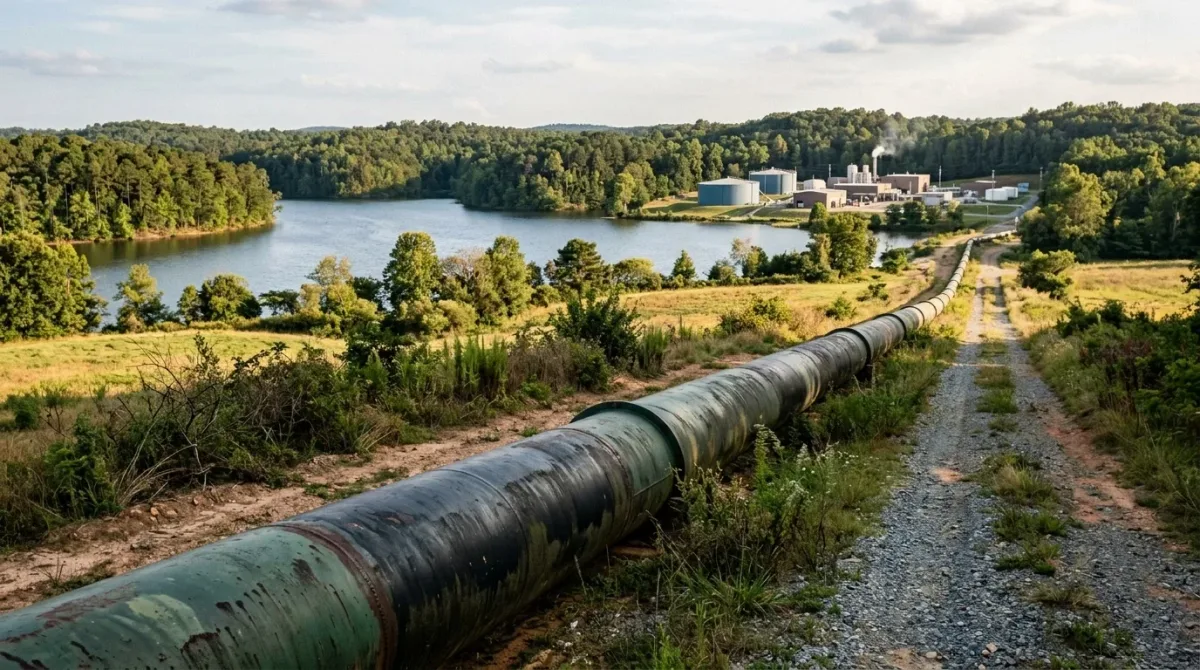
Every gallon Union County Water delivers begins in a river basin the county does not sit in. A state certificate granted May 11, 2017 lets Union County and the Town of Wingate move up to 23 million gallons a day out of the Yadkin River basin into the Rocky River basin — the legal document sitting underneath the county's entire drinking water supply.
Union County Water describes the county it serves as a “land-locked community.” The consequence is that Union County, North Carolina draws its drinking water from two projects outside its borders, delivered through roughly 40 miles of pipeline built for that purpose.
Most residents encounter this system only as a bill and a boil-water notice. It is worth understanding as a set of numbers, because those numbers are fixed by the state and the county's population is not.
What is an interbasin transfer, and why does Union County need one?
North Carolina regulates moving water from one river basin to another. Union County Water serves customers whose taps sit in the Rocky River basin while its raw water is drawn from the Yadkin and Catawba basins, so the state has to authorize the move.
The county's interbasin transfer certificate, held by the N.C. Department of Environmental Quality, names the Yadkin River (basin 18-1) as the source and the Rocky River (basin 18-4) as the receiving basin. Union County and the Town of Wingate are the applicants.
The 23.0 million gallons per day figure is not a plant rating. DEQ calculates it on an average-day-of-the-maximum-month basis — a ceiling on transfer, not a promise of treated water.
How much water is the county allowed to take, and from where?
Three arrangements make up the supply picture in the state's records. Two are transfers; one is a purchase from a neighboring county.
| Source | Basin and location | Authorized amount | Ownership |
|---|---|---|---|
| Catawba River Water Supply Project | Catawba basin; plant at Van Wyck, S.C. | 5.0 MGD grandfathered transfer | Co-owned with Lancaster County Water and Sewer District |
| Yadkin River Water Treatment Plant | Yadkin basin; intake at Norwood on Lake Tillery | 23.0 MGD under the 2017 certificate | Wholly owned and operated by Union County Water |
| Anson County purchase agreement | Yadkin River basin service area | 4 MGD of purchased supply | Contract supply |
The Catawba and Anson figures come from the water conservation plan Union County filed with the state in March 2019 under the terms of the certificate; the Yadkin figure comes from the certificate itself.
What did the county build to make the Yadkin transfer real?
A permit is not infrastructure. To use the Yadkin allocation, the county built the Yadkin Regional Water Supply Project, which Union County Water puts at $300 million.
The pieces: an intake and pump station on the Lake Tillery shore at Norwood, 30 miles of raw water pipeline running west to the treatment plant, the plant itself, and 10 miles of finished water pipeline connecting it to the county's distribution system.
Construction began in 2020. The ribbon-cutting was September 21, 2023, and water first entered the distribution system on February 13, 2024, according to the utility. The county calls it the end of a nearly 20-year effort to secure a second source.
In its September 2023 announcement, the county said the new intake allows the Town of Norwood to draw four times more water from Lake Tillery than its previous infrastructure permitted — a county characterization of a benefit to its partner community, not an independently verified figure.
Hyong Yi, Union County Water administrator, called the project “a proactive investment that ensures Union County's water future to serve the needs of a growing county and build a resilient water system” in that announcement. County Manager Brian Matthews described it in the same release as “a testament to the power of a shared vision.” Both are the county's framing of its own project.
Who actually owns the plants?
Ownership determines who decides. The Yadkin River Water Treatment Plant is wholly owned and operated by Union County Water, which began operations there in 2024.
The Catawba River Water Supply Project is different. Its plant sits in Van Wyck, South Carolina, is co-owned with the Lancaster County Water and Sewer District, and is not directly operated by Union County Water. On the older half of its supply, the county is a partner rather than an operator.
What did the state require in exchange for 23 MGD?
The certificate is conditional. DEQ requires Union County to maintain three documents: a drought management plan, a water conservation plan, and a compliance and monitoring plan.
The conservation plan the county filed in March 2019 reports that per capita consumption fell from a past peak of 207 gallons per day to under 120 gallons per day. That is a 2019 figure and the county has not published an updated one in the state's IBT file.
DEQ's own summary of the certificate is explicit about the trade it represents: the transfer was approved to meet projected demand through 2050 in the Rocky River basin service area while avoiding an increase in transfers out of the Catawba.
What does this mean as Union County keeps growing?
The county's population reached 267,674 as of July 1, 2025, up 12.4 percent from the 238,267 counted in the April 2020 census — roughly 29,400 additional residents in five years, per U.S. Census Bureau QuickFacts.
The supply side of that equation is fixed by permit until the state says otherwise. The transfer ceiling is 23.0 MGD from the Yadkin and 5.0 MGD from the Catawba, plus 4 MGD purchased from Anson County under the 2019 filing.
That is the structural tension in a county adding subdivisions faster than it can add river basins: the growth is local and continuous, the water permission is state-issued and stepwise. Each new connection consumes headroom that the state, not the county, ultimately controls.
Residents in Wingate, whose town is named on the certificate alongside the county, and everyone else on the county system are inside the same allocation. The drought management plan DEQ requires is the document that governs what happens when demand meets the ceiling in a dry year.
None of this speaks to rates, and the county's public materials on the $300 million project do not break out how it is paid for. That is a separate document and a separate story.
For a related development perspective, read Union County to charge $2,000 minimum for water plan reviews.
For more context, read Complete Guide to Comic Book Collecting for Beginners.
For more context, read The Evidence on Cold Plunges Is Thinner Than You Think.
For more context, read What the WARN Act Actually Owes Workers When a Plant Closes.