
Creatine monohydrate improves performance in short, high-intensity efforts — sprints, jumps, heavy lifts — by roughly 10 to 20 percent in trained populations, according to a 2017 position stand from the International Society of Sports Nutrition that reviewed decades of trials. The effect is smaller or absent for pure endurance work, and the research base leans heavily on strength and team-sport athletes rather than distance runners or swimmers.
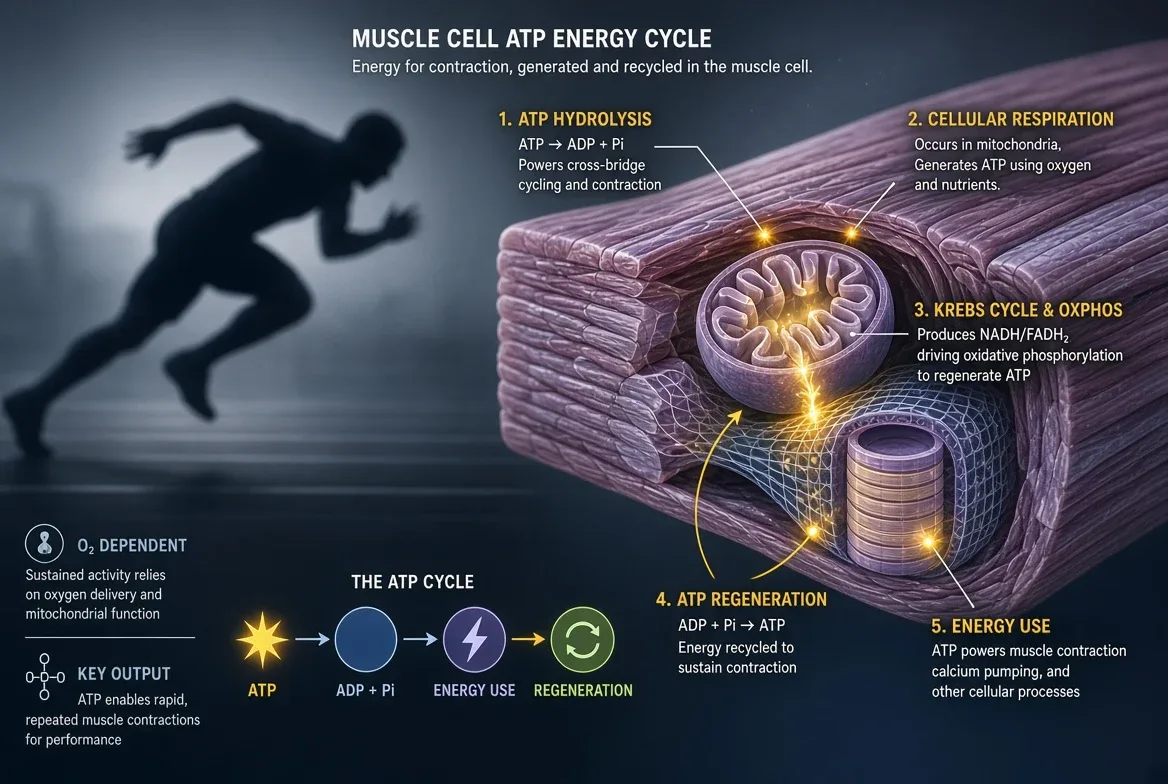
Creatine is a compound the body makes naturally and stores mostly in skeletal muscle, where it helps regenerate adenosine triphosphate (ATP) — the immediate fuel for muscle contraction — during brief, maximal bursts of effort. Supplementing with it raises the muscle's phosphocreatine reserves, which is the mechanism researchers point to when explaining why lifters and sprinters, more than marathoners, tend to notice a difference.
Does creatine actually improve athletic performance?
For repeated bouts of high-intensity exercise, yes — the effect is one of the more consistently replicated findings in sports nutrition. The International Society of Sports Nutrition's position stand, authored by Hector L. Lopez, Richard B. Kreider, and colleagues, states that raising intramuscular creatine "may help explain the observed improvements in high intensity exercise performance," with gains loosely tracking how much an individual's muscle phosphocreatine rises after supplementation.
The review reports benefits concentrated in strength, power, and intermittent-sprint sports — football, soccer, basketball, tennis — where athletes repeat short maximal efforts with brief recovery. Mayo Clinic's patient-education summary echoes that pattern, noting creatine "might help an athlete do more work during repeated short bursts of high-intensity exercise, such as lifting weights or sprinting," while flagging that evidence for other claimed uses, including injury prevention, remains thinner and less settled.
None of this makes creatine a universal performance drug. The position stand is a synthesis of many trials in mostly young, healthy, trained subjects — it is not a guarantee for any individual reader, and its authors are researchers with ties to the sports-supplement field, a context worth knowing when weighing the enthusiasm of any position paper.
How much creatine should someone take, and does "loading" matter?
Two protocols dominate the research, and the position stand quantifies both. A loading phase of about five grams taken four times daily for five to seven days raises muscle creatine stores by an estimated 20 to 40 percent. After that, three to five grams once a day maintains the elevated level, though the paper notes larger athletes may need five to ten grams to saturate stores.
The slower alternative skips loading: roughly three grams a day for about four weeks produces a similar end point without the early spike in daily dosing. The position stand also reports that taking creatine alongside carbohydrate, or carbohydrate plus protein, appears to improve how much of it the muscle retains.
| Protocol | Dose | Time to saturation |
|---|---|---|
| Loading phase | ~20 g/day (5 g × 4) for 5–7 days | About one week |
| Maintenance (post-loading) | 3–5 g/day | Sustains saturated level |
| Gradual, no loading | ~3 g/day | About 3–4 weeks |
Neither approach is described in the literature as superior for eventual performance outcomes — loading simply reaches saturated muscle stores faster. This information describes what the cited research measured; it is not individualized programming, and readers making dosing decisions for themselves should talk to a physician, dietitian, or sports-nutrition professional familiar with their health history.
Is creatine safe to take long-term?
The evidence reviewed by the International Society of Sports Nutrition describes creatine, including loading doses up to 30 grams a day, as "safe and well-tolerated in healthy individuals" across age groups from infants to older adults in the studies examined, with no clinically significant effects on kidney function, liver enzymes, or blood markers documented in that body of research. The paper also cites collegiate football data in which creatine users reported fewer injuries and less muscle cramping than non-users — the opposite of a persistent locker-room worry.
Mayo Clinic's summary is consistent with that picture for otherwise healthy people, describing creatine as "generally safe" at recommended doses and noting studies "haven't found that creatine harms kidney function when taken at recommended doses" in healthy subjects. It adds an important carve-out: people with existing kidney disease should talk to a doctor before starting, since that population is not well represented in the safety trials. Weight gain, mostly from water retained in muscle, is the most commonly reported side effect in both sources.
This is general information about a supplement's studied safety profile, not medical advice for any specific reader — especially anyone with kidney, liver, or cardiovascular conditions, who should consult a qualified clinician before adding creatine or any supplement to their routine.
Who is creatine likely to help — and who might not need it?
The clearest beneficiaries in the research are athletes whose sport demands repeated short, maximal efforts: sprinters, jumpers, throwers, and field- or court-sport athletes who combine bursts of speed or power with brief recovery windows. Healthline's review of the broader supplement literature adds that lean-mass gains during resistance training are among the more frequently replicated secondary findings, citing a six-week trial in which supplemented participants gained roughly 4.4 pounds more muscle mass on average than a control group doing the same training.
Pure endurance athletes — marathoners, long-distance cyclists — see little support for creatine improving aerobic performance directly in the cited literature, since the compound's role is tied to the ATP-phosphocreatine system that fuels short, explosive efforts rather than sustained aerobic output. Vegetarians and vegans, who typically start with lower baseline muscle creatine because dietary creatine comes mainly from meat and fish, sometimes show larger relative gains from supplementation in the smaller trials that have looked at diet type — a plausible but less extensively studied pattern than the core strength-and-power findings.
The federal Office of Dietary Supplements, which catalogs ergogenic aids reviewed for athletic performance, lists creatine among the supplements it tracks — a signal that it remains one of the more scientifically examined options in a category where most products have thin evidence behind them.
Frequently Asked Questions
- Does creatine cause dehydration or cramping? The position-stand data described above found no elevated cramping risk and, in one collegiate football sample, fewer reported cramps among creatine users than non-users. This is general information, not medical advice for any individual.
- Is creatine only useful for bodybuilders? No — the research base centers on short, high-intensity efforts, which spans sprinting, jumping, and field- or court-sport athletes as much as resistance training.
- Do I need the loading phase? No. The reviewed trials show loading reaches saturated muscle stores faster, but a slower, lower daily dose reaches a similar point in about a month.
- Is creatine safe for teenage athletes? That's an individualized medical question outside what general population research settles; a pediatrician or sports-medicine physician should weigh a minor's specific health history before any supplement decision.
For a related science perspective, read What the Research Actually Says About Creatine.
For more context, read Complete Guide to Comic Book Collecting for Beginners.
For more context, read What the Research Says About Creatine and Muscle Growth.
For more context, read How Much Protein Do You Actually Need to Build Muscle?.