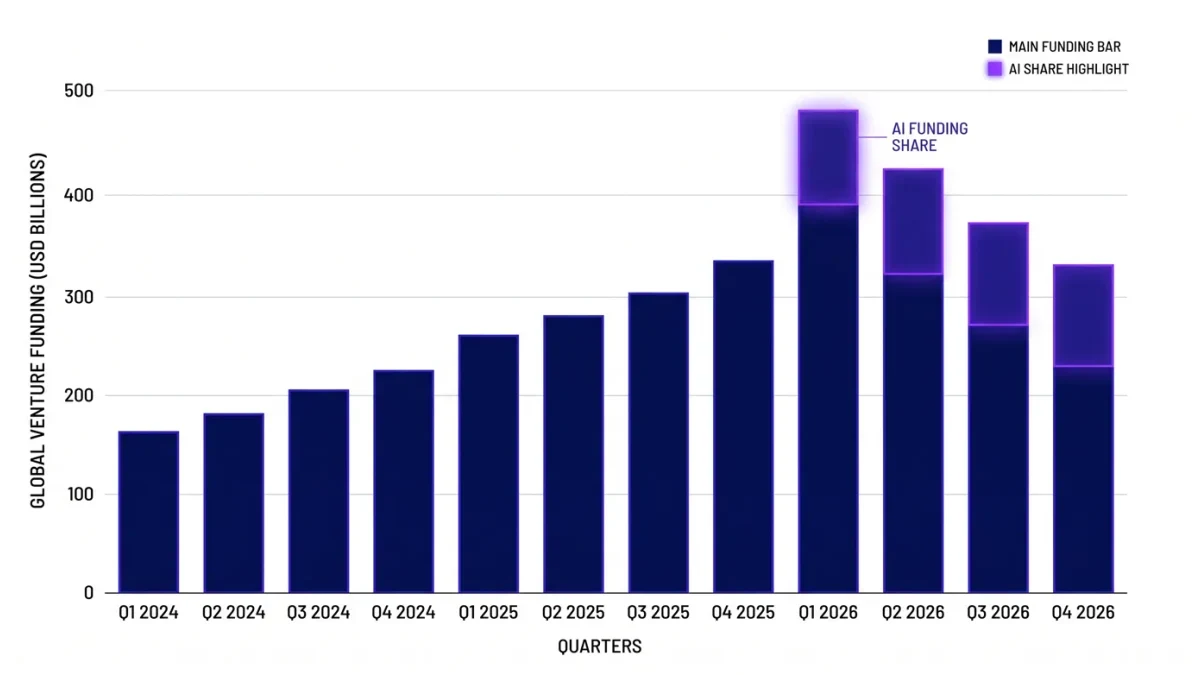

Venture funding for women's health companies fell to about $1.58 billion in 2025, down from the record $2.6 billion invested in 2024, per Silicon Valley Bank's Innovation in Women's Health Investment Report, released in March 2026. Biopharma-focused startups absorbed most of the decline — dropping from $1.3 billion to $610 million — while early data from 2026 pointed to a rebound in seed and Series A rounds.
What the report measured
SVB's annual report tracks venture dollars into companies whose primary market is women's health: fertility, pregnancy and postpartum care, menopause, contraception, and related diagnostics. Per the March 2026 edition, the 2025 total of $1.58 billion ended two years of record activity — 2024's $2.6 billion was itself up about 55 percent from 2023. The biopharma segment's fall from $1.3 billion to $610 million accounted for roughly two-thirds of the total decline, per the report's coverage by Biopharma Dive.
The AI valuation gap
The report's most quoted figure is a valuation split: AI-enabled women's health companies reached a median pre-money valuation of $35.0 million in 2025, against $12.3 million for comparable companies without an AI angle, per the SVB report. That is nearly a threefold premium attached to a technology category rather than a clinical outcome — and it shapes which companies get built. Fertility tracking, triage chat, and imaging-interpretation tools attract capital; a new pessary, a better postpartum hemorrhage protocol, or a contraceptive clinical trial does not, because the investor story is harder to tell and the regulatory path longer.
Why the decline is not uniformly bad news
A funding contraction trims duplication. The 2024 peak funded many overlapping care-navigation and telehealth platforms; 2025's repricing pushed consolidation and forced startups toward revenue rather than growth metrics. SVB's own early-2026 signals — a fresh wave of seed rounds — suggest the sector is re-entering at smaller sizes with clearer clinical claims. For patients, the practical translation is slower feature churn in period-tracking and fertility apps, not less access to clinical care itself.
The context most coverage skipped
Women's health remains a small share of overall US biopharma and digital health funding — historically under 3 percent, per analyses of NIH and venture data — so the 2025 decline moves a small base, not a mature market. The more consequential number in the report is the AI premium itself: $35 million medians are being set at a stage when no AI women's-health product has yet cleared the evidence bar of a large published outcomes trial. Whether 2026's smaller rounds buy stronger trials or more software is the question that will decide the next two years.