Sleep often changes during menopause because three forces converge at once: falling estrogen and progesterone, the vasomotor symptoms they drive, and the natural aging of sleep itself — and roughly half of women report sleep difficulties during the menopause transition, per data from the Study of Women's Health Across the Nation, an NIH-supported cohort that has followed thousands of women since 1996. The change is common, measurable, and — importantly — treatable.
It explains what the research shows about why sleep breaks down in this window and which remedies have evidence behind them. Decisions about hormones, medications, or testing belong with your own clinician, who knows your history.
What is the menopause transition, and when does sleep change?
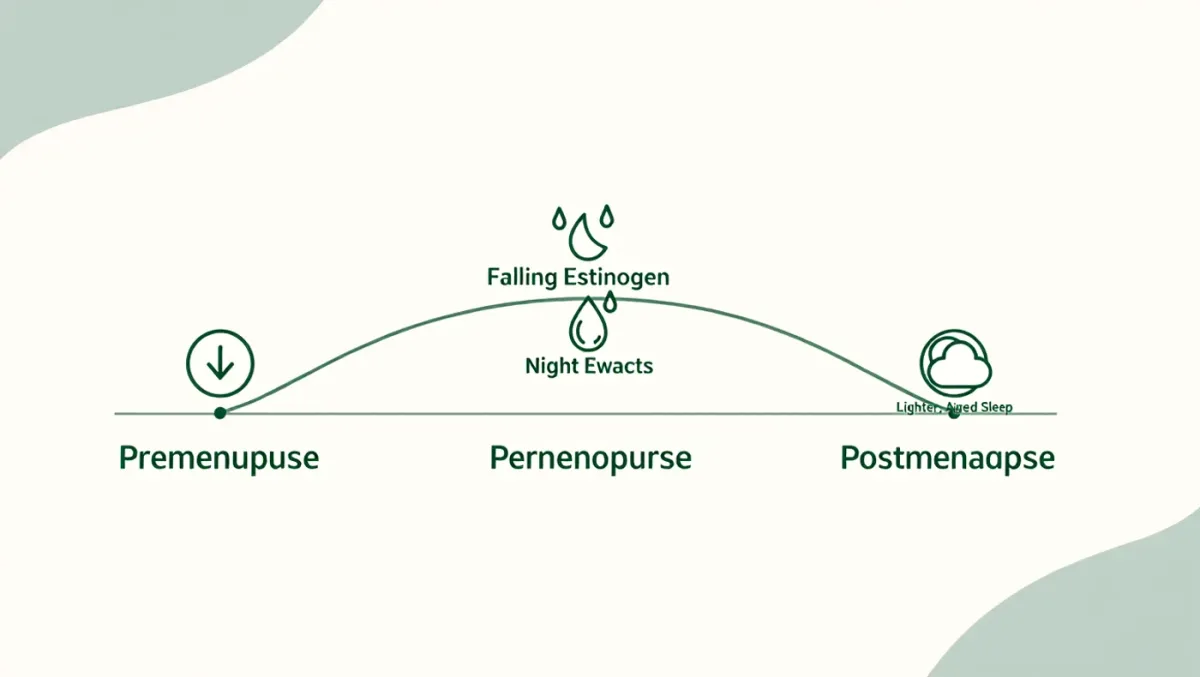
The menopause transition, also called perimenopause, is the years before the final menstrual period, when ovarian hormone production becomes erratic and then stops; menopause itself is defined retrospectively as twelve months without a period, per ACOG's 2014 committee opinion on staging the menopause transition. The transition typically begins in a woman's mid-40s and lasts four to eight years.
Sleep complaints rise well before the last period. In SWAN's sleep substudy, published in Sleep in 2010, the likelihood of difficulty falling asleep and staying asleep increased across the transition stages, and the rise was not fully explained by hot flashes alone — hormone fluctuation, mood, and age-related sleep change each contributed.
How exactly do hormones affect sleep?
Three mechanisms are well documented. First, thermoregulation: falling estrogen narrows the brain's thermoneutral zone, the range of body temperatures in which sleep is comfortable, so small internal temperature shifts trigger the heat waves and night sweats known as vasomotor symptoms — the number-one self-reported reason for midlife night waking in SWAN and similar cohorts.
Second, progesterone, which declines through the transition, has a mild sedating effect and supports breathing stability; its loss is one proposed contributor to the increased snoring and sleep-disordered breathing seen in midlife women, per the American Academy of Sleep Medicine. Third, serotonin and GABA systems that estrogen supports also influence sleep continuity, which is one reason the relationship is not purely about temperature.
Isn't sleep just worse with age anyway?
Partly, yes — and this matters for expectations. Sleep architecture, the structure of sleep stages across the night, changes with age in both sexes: deep slow-wave sleep declines, sleep becomes lighter and more fragmented, and the circadian rhythm shifts earlier, per the National Institute on Aging. Women in midlife therefore experience an aging effect and a hormonal effect stacked on top of each other.
SWAN's data help separate them: sleep quality worsened across transition stages more than would be predicted from age alone, with the steepest deterioration in late perimenopause. That distinction is quietly encouraging — a hormonal component means a hormonal (or symptom-targeted) lever exists, unlike chronological aging.
What actually helps, according to evidence?
The strongest evidence belongs to cognitive behavioral therapy for insomnia — a structured program, usually six to eight sessions, that rebuilds sleep timing, reshapes sleep-related thinking, and reduces time awake in bed. The American College of Physicians, in its 2016 guideline published in Annals of Internal Medicine, recommended CBT-I as the first-line treatment for chronic insomnia in adults, over medication.
| Approach | Evidence status |
|---|---|
| CBT-I | First-line for chronic insomnia per ACP, 2016; durable benefit in trials |
| Estrogen-containing hormone therapy | Most effective treatment for vasomotor symptoms per the Menopause Society's 2022 position statement; individual risk review required |
| Fezolinetant | FDA-approved May 2023 for moderate-to-severe vasomotor symptoms; improves sleep secondarily in trials |
| CBT for hot flashes | Reduces bother and improves sleep quality in randomized trials, without changing hot-flash frequency |
| Regular exercise | Mixed evidence for sleep improvement; benefits mood and overall health regardless |
| Black cohosh and other botanicals | Inconsistent results; not endorsed by the Menopause Society for vasomotor symptoms |
Hormone therapy deserves its calibrated sentence: per the Menopause Society's 2022 position statement, estrogen is the most effective available treatment for vasomotor symptoms and the resulting sleep disruption, for women under 60 or within ten years of menopause who are appropriate candidates — with the decision resting on an individual review of risks with a clinician, not on a population rule.
What about sleep hygiene alone?
Standard advice — consistent wake time, cool bedroom, limited evening alcohol and caffeine — is a reasonable foundation, and alcohol deserves specific mention because it fragments the second half of the night and worsens thermoregulation. But hygiene alone rarely resolves midlife insomnia, per ACP guidance; it works best as the scaffolding around CBT-I rather than a substitute for it.
Sleep apnea also deserves attention here. Loud habitual snoring, witnessed pauses in breathing, morning headaches, or severe daytime sleepiness are not menopause symptoms to be endured — they are referral signals. The risk of obstructive sleep apnea rises substantially in women after menopause, per the American Academy of Sleep Medicine, and it is treatable.
Does sleeping badly during menopause predict anything long term?
Chronic insomnia is worth treating in its own right rather than as a warning light, and it is also associated with depression, worse quality of life, and higher blood pressure in midlife cohorts, per SWAN publications. Treating the sleep problem — and the vasomotor symptoms driving it — is a legitimate health goal, not vanity, and clinicians have more tools in 2026 than a decade ago.
When to talk to a clinician
Make an appointment when sleep difficulty persists more than a few nights a week for more than a month, when night sweats soak bedding regularly, or when daytime fatigue affects driving, work, or mood. Ask specifically about CBT-I, about whether you are a candidate for hormone therapy or FDA-approved nonhormonal options, and about screening for sleep apnea or thyroid disease, which can mimic menopausal sleep trouble. Seek care promptly for chest discomfort, breathlessness at night, or waking with gasping — those are cardiac and respiratory symptoms, not menopause logistics.
Frequently asked questions
Will my sleep go back to normal after menopause? For many women it improves: SWAN followed women across the transition and found sleep complaints peaked in late perimenopause and partly eased after the final period, though not to pre-transition levels for everyone. Aging effects on sleep persist in both sexes. The practical point is that the worst stretch is usually the transition itself, and it is treatable while it lasts.
Is melatonin worth taking? The evidence in midlife women is thin. Melatonin has modest, mixed trial results for sleep-onset, per the American Academy of Sleep Medicine's 2017 clinical practice guideline, which did not recommend it for insomnia. It is not dangerous for most people, but it is not a substitute for CBT-I, and supplement potency varies widely in the US market.
Do I have to accept night sweats as normal? Common does not mean untreatable. Estrogen therapy, the nonhormonal medication fezolinetant approved by the FDA in May 2023, and cognitive approaches all reduce vasomotor symptoms in randomized trials, per the Menopause Society's 2022 position statement. If night sweats regularly wreck your nights, that is a conversation worth having rather than a decade to be endured.