
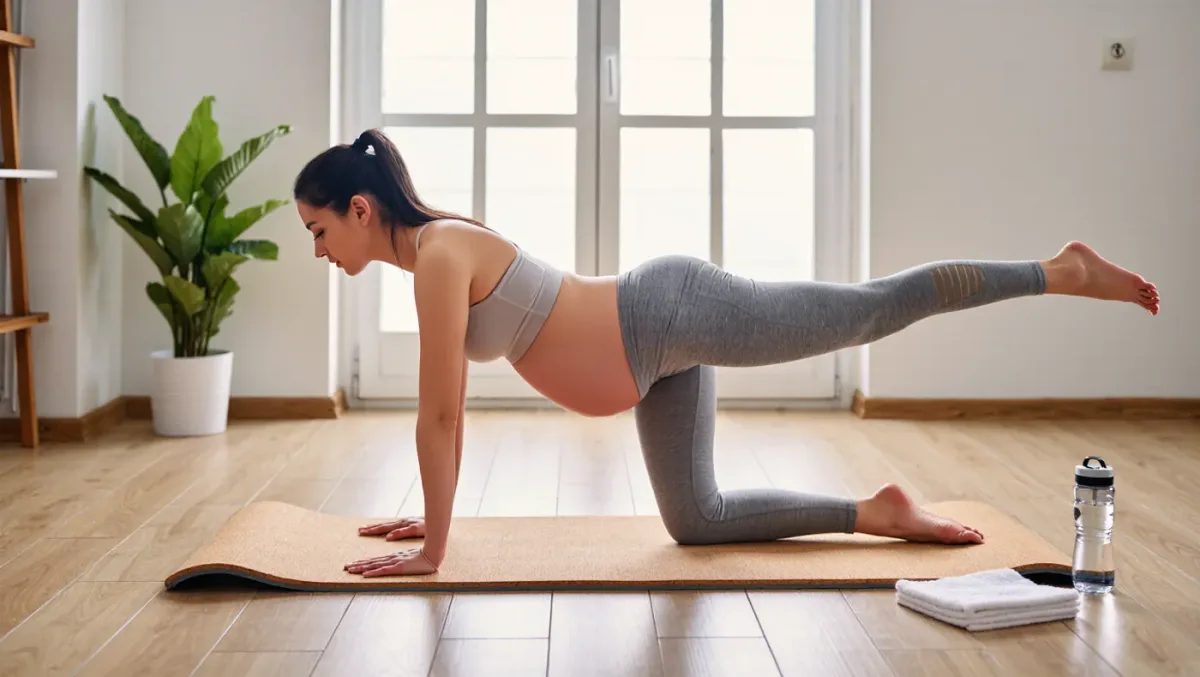
Core exercise is safe and encouraged for most pregnancies: the American College of Obstetricians and Gynecologists' Committee Opinion 804, issued in 2020, recommends that pregnant and postpartum women get at least 150 minutes of moderate-intensity activity per week, and lists no blanket ban on trunk and core work — only specific movements and sports to avoid as pregnancy advances.
This article publishes information, not medical advice. It summarizes what ACOG and the research literature say about abdominal and core training during pregnancy; it is not an exercise prescription, and your own obstetric clinician should clear any exercise plan, since pregnancy complications change the rules in both directions.
It helps to define the target. The core is not one muscle but a group of deep and superficial structures — the diaphragm above, the transverse abdominis and obliques around the front and sides, the pelvic floor below, and the back muscles behind — that work together to steady the trunk during movement. Training it in pregnancy is less about visible abs and more about keeping that system coordinated under changing loads.
What does ACOG actually say?
The 2020 committee opinion frames exercise in pregnancy as the rule rather than the exception: for people with uncomplicated pregnancies, 150 minutes of moderate-intensity aerobic and strength activity across the week, started at any point in pregnancy for those who were previously inactive. The caution side is equally specific. As pregnancy progresses, ACOG advises avoiding contact sports and activities with fall risk, scuba diving, and, in the first trimester, hot yoga and hot Pilates because of hyperthermia risk. The opinion also lists absolute and relative contraindications — conditions such as certain forms of placenta previa, incompetent cervix, or preeclampsia, among others — where exercise is restricted or off the table entirely. Those lists are the reason a clinician, not an article, is the clearing authority.
On the floor itself: after the first trimester, ACOG advises avoiding exercises done while lying flat on the back for long stretches, because the gravid uterus can compress the vein returning blood to the heart. Many traditional core moves — crunches, long supine holds — fall into that category late in pregnancy, which is a mechanical reason the emphasis shifts, not evidence that abdominal work itself is harmful.
What about diastasis recti?
Diastasis recti is a separation-like widening of the gap between the two bands of the rectus abdominis muscle along the midline, and it is extremely common in late pregnancy as the uterus expands. The evidence here is more modest than social media suggests: research has not established that any specific exercise program reliably prevents it, and a 2020 systematic review and meta-analysis published in PLOS ONE found the available studies on prevention too limited to draw firm conclusions. What clinicians generally describe is a shift in emphasis — movements that manage pressure through the abdomen and keep the deep trunk muscles working, rather than moves that bulge the midline outward. Severity and recovery vary widely, which makes postpartum assessment a clinical question rather than a self-diagnosis.
Related stories: Stretching and mobility: what the evidence actually supports · Protein needs for active women: the numbers behind the advice.
What is the best-supported core work in pregnancy?
The strongest evidence in the whole core-and-pelvis category belongs to the pelvic floor — the hammock of muscles supporting the bladder, uterus, and bowel. A 2020 Cochrane review of antenatal pelvic floor muscle training found that it reduced urinary incontinence during pregnancy, one of the most common pregnancy complaints. That finding has made supervised pelvic floor work the best-anchored recommendation in this space.
| Approach | Evidence status |
|---|---|
| Pelvic floor muscle training | Reduces prenatal urinary incontinence (Cochrane review, 2020) |
| Breath-coordinated deep trunk work, standing or on all fours | Consistent with ACOG activity guidance; specific protocols not formally compared in large trials |
| Supine crunches late in pregnancy | Discouraged after the first trimester per ACOG's flat-on-back caution |
| Programs claiming to prevent diastasis recti | Insufficient evidence for prevention claims (PLOS ONE review, 2020) |
Movements that keep the trunk upright — bird-dog, side-lying work, standing cable or band rotations, wall-supported holds — avoid the supine issue and scale naturally as the belly grows. That said, specific rep counts and progressions are program territory, and the site does not prescribe them; a prenatal fitness specialist or physical therapist can fit them to the individual.
Warning signs during any session
ACOG's committee opinion lists bleeding, dizziness, headache, chest pain, muscle weakness, calf pain or swelling, regular painful contractions, amniotic fluid leakage, and other specific symptoms as reasons to stop exercising and contact the obstetric care team before resuming. The list is worth reading in full — it is the clearest piece of practical guidance in the document, and it exists because some pregnancy complications announce themselves first during exertion.
When to talk to a clinician
Before starting or continuing core training, the conversation with your obstetric clinician matters most if you have any condition on ACOG's contraindication lists, a history of preterm birth or cervical insufficiency, bleeding, or significant pelvic pain; if you were previously sedentary, ACOG still supports starting, but the plan should be built gradually. After birth, the same logic applies in reverse: the postpartum period is the right time for a clinician or pelvic floor physical therapist to assess abdominal separation, incontinence, or pain rather than pushing through them.
Frequently asked questions
Can doing core work cause a miscarriage?
Moderate exercise has not been shown to cause miscarriage in uncomplicated pregnancies — ACOG's 2020 committee opinion recommends activity from conception onward for people without contraindications. Most pregnancy loss stems from chromosomal factors outside anyone's control, per NICHD. Exercise restrictions in specific complicated pregnancies are clinical decisions, which is why the obstetric team clears the plan rather than general guidance.
When should I stop doing exercises on my back?
ACOG advises avoiding prolonged supine exercise after the first trimester, when the uterus can compress the vena cava and reduce blood return to the heart. Symptoms such as lightheadedness or nausea in that position are an immediate stop signal. Practically, most people shift to side-lying, standing, all-fours, or supported-incline positions through the second and third trimesters.
Is it too late to start exercising in the third trimester?
No — ACOG's 2020 guidance supports beginning moderate activity at any point in pregnancy for people with uncomplicated pregnancies who were previously inactive, starting gently and building gradually. Late pregnancy is a reasonable time to begin breath-coordinated core and pelvic floor work and walking, with movements adapted to comfort, size, and the flat-on-back caution. The dose changes; the permission does not expire.
Do I need a special prenatal core class?
Not strictly — ACOG's recommendation is about activity dose and safety rules, not a specific class format. What a prenatal-certified instructor or pelvic floor physical therapist adds is adaptation to the changing body: position choices, intensity management, and screening for incontinence or pain. Self-guided movement that follows the same ACOG rules is legitimate; supervision is a fit question, not a requirement of the guidance.